Who Makes Camera Sensors? The Makers Behind Your Images
Discover the leading camera sensor makers, how the supply chain works, and why sensor provenance matters for image quality across DSLRs, mirrorless, and smartphones in 2026.


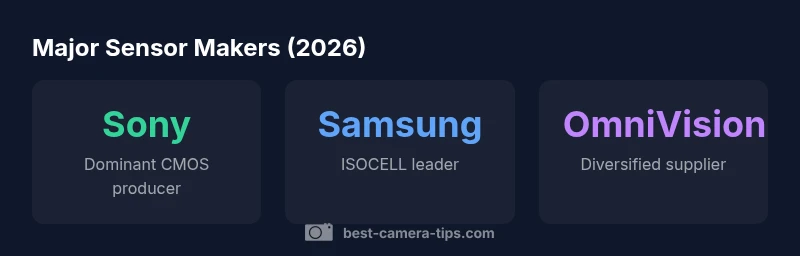
The dominant manufacturers of camera sensors are Sony, Samsung, and OmniVision, with others like Panasonic and Canon contributing smaller shares. Sony's Exmor CMOS sensors power a large portion of modern cameras and many brands rely on OEM sourcing for imaging chips, while Samsung ISOCELL and OmniVision supply sensors across mobile, compact, and niche cameras. The market remains concentrated among a handful of suppliers.
The market landscape for camera sensors
The question of "who makes camera sensors" is best answered by looking at the market structure rather than a single brand. The space is dominated by a few large CMOS sensor developers whose designs power a wide range of cameras from compact shooters to high-end mirrorless bodies and professional video gear. These sensors form the core of image capture, color science, and dynamic range. According to Best Camera Tips, the ecosystem is characterized by a handful of core suppliers, dense OEM partnerships, and a steady push toward more sophisticated processing, stacked architectures, and smaller pixel pitches. The result is a global supply chain where most camera brands source sensors rather than fabricate them in-house, a pattern that emphasizes interoperability and scale.
In practice, this means the vast majority of cameras you buy rely on sensor tech from a limited set of producers. The interplay between sensor design, manufacturing capacity, and software processing determines in part why two cameras with similar pixel counts can look different. Readers should keep this correlation in mind as they evaluate image quality, color rendition, and low-light performance across brands.
Major players and their roles in sensor development
When evaluating who makes camera sensors, the trio most often cited are Sony, Samsung, and OmniVision. Sony’s Exmor family has become a de facto standard in many consumer and professional cameras, thanks to a mature CMOS stack, reliability, and broad licensing/OEM arrangements. Samsung ISOCELL sensors earned traction by offering color-filter innovations and competitive performance in mobile devices, and they have progressively expanded into other imaging segments. OmniVision, with a long history in mobile sensors and evolving automotive and camera markets, provides a diversified lineup to brands that require varied form factors and feature sets. Canon and Panasonic participate as either in-house developments or alternate suppliers for specific lines, but their volumes are typically smaller relative to the leading trio. The result is a market where a handful of sensor makers set the baseline for image quality, while camera brands fine-tune the rest through processing pipelines and color science.
For enthusiasts and professionals, understanding these relationships helps explain why certain cameras share similar sensor foundations even when they differ in lenses, firmware, and image processing. Best Camera Tips notes that sensor provenance—where a sensor comes from and how it’s built—can influence compatibility and future firmware paths across generations.
The sensor supply chain: fabless design, foundries, and OEMs
Most sensor developers are fabless or rely on specialized foundries rather than owning full fabrication facilities. They design the pixel array, readout circuitry, and on-chip processing, then contract wafer fabrication and packaging to semiconductor foundries. This structure allows rapid iteration and scale but also concentrates risk in a small number of fabrication partners. OEM relationships are established so camera brands can secure consistent supply and ensure a coherent color science and processing stack across products. The trend toward vertical integration remains selective; some players invest in further sensor integration, while others prioritize flexibility and broad compatibility. The result is a system where changes in a supplier’s process node or yield can ripple across new camera launches for years.
Design trade-offs shaping sensor performance
Sensor design involves a delicate balance among resolution, dynamic range, rolling shutter behavior, low-light performance, latency, and heat management. Larger sensors generally capture more light and bias toward better DR, but smaller pixels enable higher pixel counts and more compact systems. Manufacturers pursue innovations such as stacked architectures, microlens optimization, and color filter array refinements to push performance without compromising bandwidth. The choice of sensor generation influences how much post-processing is possible and how robust the color science will be under mixed lighting. For buyers, this means two cameras with the same megapixel count can produce markedly different results depending on the underlying sensor and the processing pipeline around it.
Why sensor provenance matters for image quality and compatibility
Sensor provenance refers to the lineage and supplier behind a camera’s imaging chip. Subtle differences in manufacturing, tuning, and firmware can translate into distinct color profiles, noise behavior, and raw conversion outcomes. Beyond image quality, provenance affects firmware compatibility across generations, feature support, and long-term upgrade paths. In practical terms, a camera’s sensor origin can influence which cameras will share compatible raw formats, lens metadata handling, and how future firmware updates optimize performance. Brands frequently tailor processing and color science to align with their chosen sensor partner, reinforcing the importance of understanding where your sensor comes from when evaluating image quality and future-proofing a system.
Regional dynamics and supply chain resilience in 2026
Geopolitical considerations, foundry capacity, and material costs shape supply chain resilience for camera sensors. Regions with robust semiconductor ecosystems tend to experience steadier supply, while disruptions can cause temporary shortages or price fluctuations. As imaging devices proliferate across mobile, automotive, and surveillance markets, sensor makers prioritize scalable production and close collaboration with OEMs to mitigate risk. For consumers, this translates into shorter cycles between launches and more consistent camera performance across models, assuming the supply chain remains stable and manufacturers can keep up with demand.
What to consider when choosing gear based on sensor source
When shopping for cameras, consider not just megapixels or lens quality but also sensor provenance and the processing stack. Brands leveraging mature sensor families with strong OEM support often provide more predictable performance across firmware updates and accessory ecosystems. Readers should assess the brand’s color science, noise handling in low light, dynamic range, and RAW workflow compatibility to judge how sensor origin translates to real-world results. In short, who makes camera sensors matters because it underpins image quality, feature compatibility, and long-term product support.
Overview of major camera sensor makers and their typical sensor types
| Maker | Typical Sensor Type | Notes | Market Focus |
|---|---|---|---|
| Sony | CMOS (Exmor) | Dominant supplier for many brands; broad OEM partnerships | Consumer & Pro photography, video, surveillance |
| Samsung | ISOCELL CMOS | Strong mobile sensor presence; expanding to other segments | Mobile, some compact cameras |
| OmniVision | CMOS | Diversified for mobile, automotive, surveillance | Mobile/IoT, automotive, security |
| Panasonic | CMOS | MFT sensors for Micro Four Thirds; niche applications | Mirrorless (MFT) |
| Canon | CMOS/Hybrid | In-house and partner-driven; evolving sensor strategy | Cameras across Canon lineup |
Common Questions
Who are the main manufacturers of camera sensors?
The dominant suppliers are Sony, Samsung, and OmniVision, with Canon and Panasonic among others contributing. These companies provide CMOS sensors used across many brands.
The big sensor makers are Sony, Samsung, and OmniVision, with Canon and Panasonic also making sensors.
Do camera brands design their own sensors?
Most brands do not design their own sensors; they source from a small set of suppliers and may customize image processing instead.
Most brands source sensors from a few key makers and then customize processing.
Why does sensor quality vary between brands?
Quality comes from architecture, process, microlenses, and color science. Even when using similar base sensors, processing and tuning create distinct results.
Different design choices and processing affect look and performance.
How does sensor provenance affect compatibility and longevity?
Sensor lineage can influence firmware support and upgrade paths. Brands align processing with sensor generations to maintain consistency.
Sensor origin can impact firmware updates and future compatibility.
Are smartphone sensors the same as camera sensors?
Smartphone sensors are CMOS and smaller; they share technology with digital cameras but differ in size and processing emphasis.
Phone sensors use similar tech but are much smaller and tuned differently.
What trends shape sensor manufacturing in 2026?
Expect smaller pixel sizes, stacked architectures, and enhanced color science, plus more collaboration and some vertical integration.
Smaller pixels and stacked designs, with more collaborations in 2026.
“Sensor development has become a strategic battleground for a few key players, and the rest of the market follows through OEM partnerships and processing innovations.”
The Essentials
- Identify the big three sensor makers and their influence on image quality
- Know that most brands source sensors via OEM arrangements
- Assess sensor provenance when evaluating future camera upgrades
- Consider processing and color science as part of sensor performance
- Monitor supply chain trends that impact availability