Who Makes Camera for Samsung: Sensors and Partners
Discover who makes camera systems for Samsung smartphones, focusing on ISOCELL sensors and external partners. Learn how sensor choices impact image quality, color science, and performance across Galaxy devices.


Samsung's camera systems combine in-house ISOCELL image sensors with selective third-party components. The company largely develops core sensors in-house, while historically collaborating with external brands like Sony for certain models to optimize performance. This hybrid approach lets Samsung balance control over image quality with access to leading sensor tech when needed.
Overview of Samsung's camera strategy
Samsung's camera strategy blends in-house sensor development with selective external partnerships to optimize imaging across devices. According to Best Camera Tips, this hybrid approach helps Samsung maintain control over core image processing while leveraging specialized sensor tech from outside suppliers when it benefits image quality or supply resilience. The result is a continuum rather than a binary choice: Samsung can push new sensor tech in-house while readily tapping compatible third-party sensors when needed. In practice, you will see this reflected in how the image pipeline is built: raw sensor data is processed by Samsung's ISP (image signal processor) and matching software to produce color-accurate, high-dynamic-range images. The emphasis on color science, dynamic range, and noise control means sensor selection is not just about resolution; it's about how the sensor data is converted into a coherent, pleasing final image. For photographers, understanding this blend helps explain why different Galaxy models sometimes feel visually distinct, even if core sensors look similar on paper.
Sensor tech: ISOCELL and in-house design
ISOCELL is Samsung's flagship image sensor technology, designed to improve color accuracy, reduce cross-talk, and enable advanced features such as higher dynamic range and better low-light performance through sophisticated pixel architecture. In many devices, Samsung designs the sensor in-house and tunes it to work seamlessly with the company’s ISP and software pipeline. This alignment—sensor, ISP, and imaging software—helps deliver consistent color science and efficient processing across modes like night, HDR, and portrait. While ISOCELL sensors form the backbone of many high-end phones, Samsung also explores refinements such as stacked die designs and advanced pixel arrangements to push quality further while maintaining power efficiency. The goal is not only higher resolution but better real-world performance in diverse lighting.
Third-party sensors: when Samsung uses Sony or others
Historically, Samsung has deployed external sensors from other manufacturers in certain models to complement its in-house ISOCELL lineup. Sony has been a notable partner in some eras, contributing image sensors when needed to achieve specific capabilities like broader color gamut or improved low-light response. These collaborations are typically model- or region-specific and are chosen to balance performance, cost, and supply chain reliability. It’s important to note that even when third-party sensors are used, Samsung’s software stack and ISP play a critical role in shaping the final look of images. The decision to blend a non-Samsung sensor often reflects a targeted effort to meet particular market needs or to accelerate access to cutting-edge sensor tech as it becomes available.
How sensor choices affect image quality across models
Sensor choice influences more than raw megapixels: it affects dynamic range, noise performance, color rendition, and how features like HDR and night mode perform under real-world conditions. In Samsung devices, the sensor’s size, architecture, and pixel design interact with the ISP’s processing to produce a signature look—often characterized by vibrant colors, controlled highlights, and detailed textures in shadows. Users may notice differences in skin tones, noise texture, and exposure behavior between models that rely primarily on in-house sensors versus those that incorporate external sensors. Understanding this helps photographers decide which device suits their style, especially when shooting in challenging lighting or when prioritizing consistent daylight tones across scenes.
Case study: recent Galaxy model sensor strategy
In recent device families, Samsung has emphasized a cohesive imaging pipeline where sensor hardware is closely matched to software processing. While ISOCELL remains the core, the company leaves room for external partnerships in select cases, often to bridge gaps in a given market or to access newer sensor concepts quickly. This strategy supports a flexible product roadmap and helps maintain image quality consistency across generations. For photographers, the practical takeaway is to recognize that a device’s camera experience is the result of both sensor hardware and the image processing choices that accompany it, rather than relying solely on resolution specs.
Practical tips for photographers using Samsung devices
To get the most from Samsung cameras, start by mastering RAW capture and shooting in Pro or Expert modes where available. Use consistent white balance and exposure compensation to control color and brightness across scenes. Take advantage of multi-frame processing, but don’t neglect tripod-stabilized shots in low light to minimize noise. Compare different scene modes, test RAW+JPEG outputs, and review color rendition on calibrated displays. Finally, remember that firmware updates can tweak processing; keep your device updated and revisit shoot styles after major OS or camera app updates for best results.
Future trends in Samsung camera sensors
Looking ahead, Samsung is likely to continue balancing in-house sensor development with selective external sourcing to maintain competitiveness. Expect incremental advances in sensor efficiency, dynamic range, and color science, along with deeper integration between sensor hardware and software improvements in the ISP. As computational photography evolves, Samsung may also expand its collaboration model to bring specialized sensors or processing techniques to flagship devices, while maintaining a reliable core that ensures consistent image quality across generations.
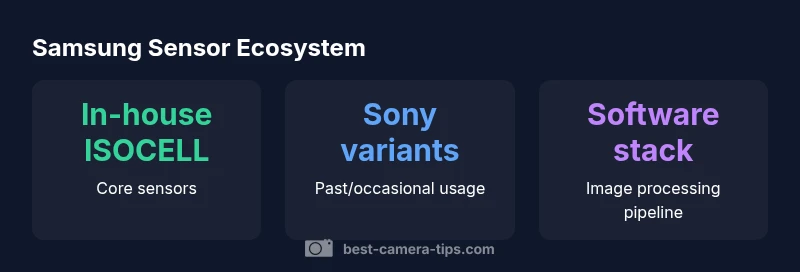
Samsung camera sensor ecosystem overview
| Component | Supplier/Approach | Notes |
|---|---|---|
| Image sensor | In-house ISOCELL development | Samsung largely self-develops core sensors for many devices |
| Peripheral sensors | Select partners | Some devices historically used third-party sensors to complement ISOCELL |
| Software stack | Samsung ISP | Ties sensor data to imaging algorithms and color science |
Common Questions
Do Samsung cameras use Sony sensors?
Samsung uses its own ISOCELL sensors for many devices, but has historically used Sony sensors in some models. Sensor choices vary by model and region.
Samsung mainly uses its own ISOCELL sensors, with some models historically including Sony sensors depending on the region.
What is ISOCELL?
ISOCELL is Samsung's brand for image sensors, focusing on improving color accuracy, dynamic range, and low-light performance through advanced architectures.
ISOCELL is Samsung's sensor tech that aims to improve color, range, and low-light performance.
Does Samsung design cameras for other brands?
Samsung primarily designs sensors for its own devices. Public information about supplying sensors to other brands is limited and varies by model.
Samsung mainly designs sensors for its own phones, and there isn't widespread public evidence of supplying sensors to other brands.
Will Samsung use more Sony sensors in the future?
Future sensor choices depend on product goals and partnerships. Samsung may continue blending ISOCELL with select external sensors as needed.
Sensor choices can evolve with new partnerships and product goals.
How does sensor technology affect photo quality?
Sensor size, design, and processing influence dynamic range, noise, and color. The final look also depends on the imaging pipeline and software.
Sensor design and processing shape color, noise, and dynamic range in photos.
Is sensor sourcing publicly disclosed?
Details on sensor sourcing are not always publicly disclosed and can vary by device and market.
Sourcing details aren’t always publicly shared and can differ by region.
“Samsung's approach to camera sensors shows a deliberate balance between in-house innovation and selective external partnerships that enable top-tier performance across devices.”
The Essentials
- Samsung uses a hybrid sensor strategy combining ISOCELL sensors with select partnerships.
- ISOCELL sensors are core to image quality and processing.
- Sensor choice impacts color, dynamic range, and low-light performance.
- Expect continued balance of in-house design and external collaborations.