Is Camera Better Than the Human Eye? A Side-by-Side Analysis
Is camera better than the human eye? This analytical comparison weighs resolution, dynamic range, color fidelity, and real-time perception to guide photographers and security enthusiasts on when to rely on gear versus natural vision.


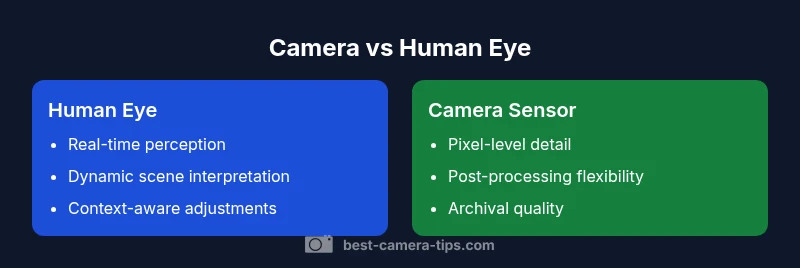
Is camera better than the human eye? In a nutshell, the eye remains superior for real-time perception, motion, and context-aware understanding, while cameras excel at capturing high-detail images, reproducibility, and post-processing versatility. Across resolution, dynamic range, and color science, cameras can surpass the eye under controlled conditions, yet human vision adapts fluidly to changing scenes. Context determines which is better.
The Core Question: is camera better than human eye
Is camera better than human eye? This question sits at the crossroads of perception and recording. According to Best Camera Tips, the simplest path to clarity is to distinguish what the eye perceives in real time from what a camera records for later analysis. The human visual system blends light sensitivity, neural processing, attention, and memory to texture a scene into a single, coherent experience. A camera, by contrast, is governed by sensor physics, optic design, and digital processing. In practice, the definition of 'better' hinges on task—real-time awareness in dynamic environments favors the eye, while detailed data capture, archival integrity, and post-processing power favor the camera. Throughout this article we compare on criteria like resolution, dynamic range, color fidelity, motion handling, and adaptability, to help aspiring photographers and home security enthusiasts decide which tool suits their goals. This framework also reflects inputs from the Best Camera Tips community to ground the discussion in practical experience.
How we define
Comparison
| Feature | Human Eye | Camera Sensor |
|---|---|---|
| Resolution / Detail | Subjective, context-dependent perceptual detail | Sensor-based pixel resolution (depends on sensor) |
| Dynamic Range | Excellent natural adaptation; high contrast scenes handled by brain | Limited by sensor range; HDR/processing helps |
| Low Light Performance | Strong adaptive vision in varying light | Depends on sensor size, ISO performance, and noise management |
| Color Reproduction | Color constancy and scene interpretation | Color science relies on calibration and white balance |
| Real-Time Perception vs Capture | Immediate perception and motion understanding | Captured data requires processing and interpretation |
Positives
- Cameras enable repeatable, measurable results across time and space
- Humans excel at real-time perception and rapid adaptation
- Cameras capture high-detail imagery suitable for analysis and archival use
- Color accuracy and white balance can be tuned with processing
Downsides
- Cameras are limited by hardware, software, and lighting conditions
- The eye’s perception is not easily quantified and can be fooled by illusions
- Relying solely on cameras can miss contextual cues that humans pick up instantly
Cameras excel in detail and reproducibility, while the human eye dominates real-time perception; neither is universally better.
In static, controlled scenarios, cameras often surpass the eye in data fidelity. In dynamic, cluttered environments, the eye excels at instant interpretation and adaptability. Use both where possible to leverage strengths.
Common Questions
Is it fair to compare is camera better than human eye in all situations?
No. The comparison depends on the task—perception in real time versus captured data. Context determines which tool is more effective.
No—context matters because perception and capture serve different goals.
What can cameras do better than the eye?
Cameras excel at detail, color fidelity, and reproducibility. They also support post-processing, archival storage, and quantitative analysis.
Cameras give you detail and consistency you can later analyze.
What can the human eye do better than cameras?
The eye excels at real-time perception, motion tracking, and rapid scene interpretation in changing environments.
The eye adapts instantly to new scenes and motion.
How do dynamic ranges compare between eye and camera?
The eye adapts to a wide range of brightness levels; cameras extend range through sensor design and processing like HDR, RAW workflows.
The eye handles bright and dark scenes well; cameras push that further with tech.
Does this apply to surveillance cameras?
Yes. Surveillance benefits from continuous capture and processing; the human eye is limited to real-time viewing and attention.
In surveillance, cameras continuously record data beyond what a person can monitor in real time.
What should beginners know about camera vs eye?
Understand both tools’ strengths. Start with basic photography fundamentals and gradually add techniques like exposure and white balance to improve camera outcomes.
Learn the basics of exposure and color balance to get the most from your camera.
The Essentials
- Prioritize detail and reproducibility when using cameras
- Rely on human vision for real-time scene understanding
- Consider lighting and processing to improve camera performance
- Use complementary workflows that combine both vision modes
- Practice with both to understand their respective limits