Difference Between Camera and Phone Camera: A Practical Guide
Explore the difference between camera and phone camera, covering sensor size, optics, processing, and ideal use cases. Learn when a dedicated camera beats a phone and how to choose for your photography goals.


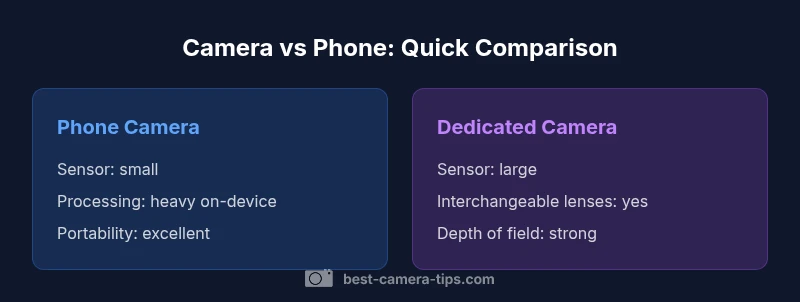
The difference between camera and phone camera centers on purpose-built hardware and software: dedicated cameras use larger sensors, brighter optics, and flexible controls, while phones rely on compact sensors, computational photography, and built-in software shortcuts. This combination yields higher image quality and more creative control with a dedicated camera, whereas a phone camera emphasizes portability, speed, and convenience for everyday shooting. Your choice hinges on image quality needs, portability, and budget.
Why the difference matters
For most readers, understanding the difference between camera and phone camera is not about brand names; it's about capabilities and limits that shape daily shooting decisions. The term 'difference' isn't only about resolution; it's about sensor size, lens flexibility, exposure control, and how the image is captured from capture to store. In the context of social sharing, print quality, or professional grading, the distinction becomes more pronounced. The camera versus phone camera conversation often starts with sensor size: specialized cameras commonly use sensors significantly larger than those found in smartphones, which means more light gathering, better dynamic range, and cleaner shadows in challenging scenes. However, since 2015-2026, phone cameras have increasingly closed the gap thanks to multi-frame synthesis, computational HDR, and smarter image processing. The Best Camera Tips analysis, 2026, shows that while the gap narrows in everyday scenes, dedicated cameras still outperform in controlled lighting, fast action, and professional grading workflows.
Core hardware differences: sensors, lenses, and optics
Understanding the hardware gap helps explain why results differ. Phone cameras are constrained by tiny sensors and compact lenses, designed for pocket convenience. They rely on stacked or backside-illuminated sensors paired with small apertures and fixed lenses. Dedicated cameras use larger sensors (often APS-C or full-frame) that gather more light per pixel, enabling cleaner shadows and higher signal-to-noise ratios. Lenses on dedicated systems are interchangeable, allowing you to tailor focal length, speed, and perspective, from ultra-wide to telephoto. This flexibility translates into sharper mid-tones, better color fidelity, and more precise control over depth of field. The trade-off is weight, cost, and the need to manage additional gear. In practice, the hardware gap means phones excel in portability and speed, while dedicated cameras enable deliberate, high-quality image-making across varied genres.
Image quality: Dynamic range and noise
Image quality hinges on dynamic range, noise performance, and color rendition. Large sensors capture more light per pixel, delivering superior dynamic range and smoother tonal transitions in highlights and shadows. Noise suppression benefits from physical sensor area and better pixel pitch, especially in low light. Computational tricks on phones—like multi-frame stacking, denoise algorithms, and tone mapping—improve appearance in typical scenes, but they can also mask limitations in raw data and reduce texture fidelity. In controlled studio or outdoor conditions with good lighting, dedicated cameras consistently outperform entry-level smartphone shots, particularly when shooting RAW and applying careful post-processing. The takeaway is that noise and banding are mitigated more effectively with larger sensors and higher-quality optics, which is why hobbyists and professionals still invest in dedicated bodies for demanding work.
Lenses, focal length, and framing
Lenses define the creative vocabulary. Phone cameras generally rely on fixed, compact lenses optimized for everyday scenes, with simulated focal lengths achieved via software. Dedicated cameras offer interchangeable lenses that span ultra-wide, standard, and telephoto options, delivering different perspective and depth-of-field control. Faster glass (lower f-numbers) enables brighter framing in dim light and shallower depth of field, producing subject separation that phones often imitate with software. This optical flexibility matters for portraits, landscapes, macro, and astrophotography, where precise framing and optical quality are essential. The lens ecosystem on a dedicated system is a major deciding factor for photographers who want true optical versatility rather than pixel-peeping at small crops from a phone.
RAW support and image processing pipelines
RAW capture preserves sensor data with minimal processing, giving photographers maximum latitude in post. Phone cameras increasingly offer RAW options, but the RAW files and pipeline differ from traditional camera systems. Dedicated cameras provide more consistent color science, broader dynamic range, and robust post-processing workflows with desktop software. While smartphones excel in on-device processing—HDR, color enhancement, and noise reduction—their RAW outputs can still require careful color grading and noise management. In short, RAW workflows are generally more predictable and powerful on dedicated cameras, especially for printing large formats or compiling a cohesive gallery where uniform processing matters.
Autofocus, exposure, and shooting speed
Autofocus and electronic performance vary between platforms. Phones use a mix of phase-detection, contrast-detection, and advanced subject-tracking to lock focus quickly, aided by AI-based scene analysis. Dedicated cameras offer fast, reliable AF systems with dedicated sensors for motion tracking, which matter in sports, wildlife, and action photography. Burst rates on phones have improved dramatically, but uninterrupted burst shooting at high resolutions is often superior on dedicated bodies with optimized buffer management. Exposure control remains more tactile on dedicated cameras, especially with manual metering, histograms, and zebra patterns. The result: phones shine for spontaneous moments, while dedicated systems excel in precision and reliability under challenging conditions.
Video capabilities and stabilization
Video on phones has evolved rapidly, delivering high-resolution footage with impressive electronic stabilization and color processing. However, dedicated cameras can offer higher bit rates, more flexible color pipelines, log profiles, external microphones, and more robust stabilization rigs through gimbals and stabilizers. For creators who require seamless color grading in post, extended dynamic range, or professional codecs, a dedicated camera provides a higher ceiling for video quality. Still, for vlogging, travel videos, and quick social sharing, a modern phone camera is often sufficient and extremely convenient.
Durability, battery life, and form factor
Form factor and durability influence where and how you shoot. Phones are pocketable, always on-hand, and tough enough for many day-to-day scenarios. They rely on integrated batteries, which offer all-day use under typical workflows but can sour during long shoots with heavy processing. Dedicated cameras add weight and bulk but allow for separate power options, extended batteries, and rugged housings designed for weather resistance and professional environments. The practical upshot: a phone keeps you shooting on the move; a dedicated body stands up to longer sessions and harsher conditions with potential for external power and weatherproofing.
Ecosystem, workflow, and editing
Workflow matters as much as the capture itself. Phones pull your entire workflow into one device, enabling rapid capture, editing, and sharing. Desktop and cloud-based workflows are often more sophisticated on dedicated cameras, with RAW files requiring a computer and specialized software. This separation can slow you down but yields greater control over color, tonality, and finished output. Whether you rely on mobile apps or desktop suites, understanding how each platform imports, stores, and exports files affects your efficiency and final quality. Having a strategy for file management, backups, and versioning is essential regardless of the camera choice.
Real-world scenarios: When to choose each tool
If your priority is portability and social sharing, phone cameras dominate most daily needs. Shoot family moments, street scenes, or quick travel photos with minimal setup. If you regularly shoot in variable lighting, want creative control over depth of field, or require precise color grading for prints, a dedicated camera is worth the investment. Portraits, landscapes, action, and studio work typically benefit more from a dedicated body and appropriate lenses, while candid street photography often benefits from the phone's immediacy and silence. In mixed-use cases, many photographers carry a phone as a supplementary tool and reserve the dedicated camera for more demanding projects.
How to bridge the gap: accessories and hybrid approaches
Bridge the gap by using a complementary setup rather than treating one device as a substitute for the other. Accessories like external microphones, tripods, and neutral-density filters improve video and stills capabilities of a camera system. For phone users, consider add-ons such as clip-on lenses, portable lighting, and tripods to extend creative possibilities. Some hybrid workflows involve capturing RAW on a mirrorless or DSLR and quickly transferring selects to the phone for social sharing, combining the best of both worlds. As you grow, you can refine your kit to align with your preferred genres and shooting pace.
Common myths about camera vs phone camera
Myth: phones will always outpace dedicated cameras in image quality. Reality: while phones have improved dramatically, dedicated cameras still offer superior control, sensor performance, and lens options in many scenarios. Myth: you only need one device. Reality: most serious shooters benefit from a primary camera for quality and a phone for immediacy and quick sharing. Myth: more megapixels equal better images. Reality: pixel quality, dynamic range, and processing matter more than sheer pixel count. Understanding these nuances helps you select the right tool for the job.
Comparison
| Feature | Phone camera | Dedicated camera |
|---|---|---|
| Sensor size | Small/compact | Larger (APS-C/full-frame) |
| Lenses | Fixed built-in lenses | Interchangeable lenses (various focal lengths) |
| RAW and flexibility | Limited RAW options on many models | Full RAW/linear workflow on most dedicated cameras |
| Dynamic range and noise | Improved via processing but sensor limits remain | Better noise handling and DR with larger sensors |
| Autofocus and speed | Excellent subject detection on smartphones | Fast, configurable AF with tracking on dedicated bodies |
| Video capabilities | High-res, strong stabilization in phones | Higher bit rates, logs, and external mic options on cameras |
| Battery life | Depends on usage, typically moderate | Longer sessions supported with removable batteries |
| Size and weight | Slim, pocketable | Bulkier, requires carrying case |
| Cost of entry | Low to mid, especially if you own a phone | Higher upfront cost for body + lenses |
| Workflow & editing | Mobile editing pipelines | Desktop-based RAW workflows with professional software |
Positives
- Portable and ready for immediate sharing
- Superior image quality and flexibility with dedicated cameras
- Advanced video capabilities and external accessory support
- Wide lens ecosystems expand creative options
Downsides
- Requires extra gear, cost, and maintenance
- Bulkier and less convenient for everyday carry
- Professional setups demand more time and learning curve
Dedicated cameras still lead in image quality and creative control; phones dominate for portability and everyday shooting.
If you prioritise image quality and lens flexibility, a dedicated camera is the better long-term investment. If convenience, instant sharing, and spontaneous moments drive your needs, a modern phone camera is more than capable for most scenarios. The Best Camera Tips team recommends evaluating your typical subjects, environment, and editing workflow to choose wisely.
Common Questions
What is the main difference between a camera and a phone camera?
The main difference lies in hardware and processing: dedicated cameras use larger sensors and interchangeable lenses for superior optical quality and control, while phone cameras rely on compact sensors and computational photography to deliver convenience and real-time enhancements.
The core difference is hardware and processing: cameras give you better optics and control, phones give you convenience and smart processing.
Can a phone camera compete with a dedicated camera in low light?
Phones have improved a lot in low light due to computational photography, but dedicated cameras generally outperform in very dim conditions thanks to larger sensors and faster lenses. Your results depend on gear, technique, and lighting.
Phones are getting better in low light, but dedicated cameras still win when lighting is very poor.
Do dedicated cameras shoot better video than phones?
Dedicated cameras offer higher bitrate options, broader color profiles, and external mic support, which can lead to superior video quality in professional settings. Phones are excellent for casual video and quick sharing.
Yes, for professional-style video, dedicated cameras usually beat phones, though phones are great for everyday video.
Is RAW photography possible on phones?
Many modern phones support RAW capture, enabling more flexible editing. However, the RAW experience can vary by device and software, and post-processing on a computer often yields the best results.
Some phones capture RAW, but the workflow can differ by model.
Why would I need interchangeable lenses?
Interchangeable lenses expand creative options, allowing you to optimize for portraits, landscapes, macro, or telephoto work. This flexibility is a core advantage of dedicated camera systems.
Changing lenses gives you different looks and better control.
What budget is typical for starting a dedicated camera system?
A starter system generally involves a camera body plus at least one lens, plus accessories. Costs vary widely by brand and sensor size, so plan for a range that fits your goals and growth plan.
It depends on your goals, but expect to invest in a body, a lens, and some basic gear.
The Essentials
- Assess your typical shooting conditions before buying.
- Evaluate sensor size and dynamic range as primary quality indicators.
- Prioritize portability and quick-sharing for everyday use.
- Consider investing in lenses or accessories for growth.
- Experiment with RAW workflows to maximize flexibility.