Camera or Phone for Travel: A Practical Side-by-Side Guide
Compare dedicated cameras and smartphones for travel, focusing on image quality, portability, battery life, and cost to decide which tool best fits your adventures.


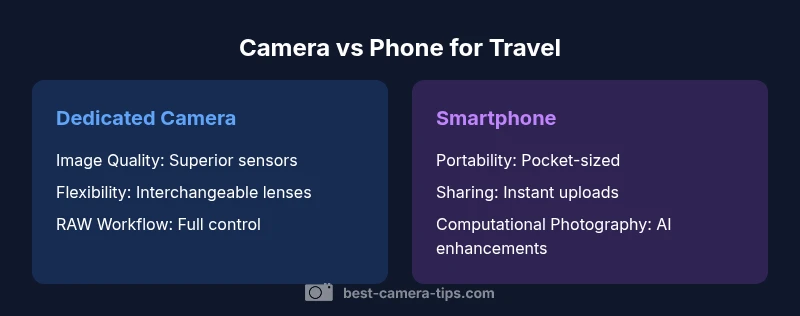
For travel, the choice between a camera or phone hinges on image quality versus convenience. A dedicated camera often delivers superior sensor performance, better low-light results, and more creative control, while a modern smartphone provides instant sharing, lighter gear, and overall ease. This quick comparison highlights the core trade-offs to help you decide quickly.
Why the travel decision matters
When you’re on the road, the gear you bring shapes what you can capture and how you experience your trip. The question camera or phone for travel isn’t about one device being universally better; it’s about which tool aligns with your priorities. If your aim is to document the trip with minimal fuss and share memories in real time, a smartphone often wins. If you’re chasing higher image quality, more creative control, or plans for large prints, a dedicated camera may be worth the extra bulk. Best-in-class cameras can push the envelope in low light and challenging conditions, while smartphones excel with convenience, quick editing, and seamless cloud workflows. By understanding your typical travel scenarios—street photography, landscapes, nightlife, or family moments—you can make a pragmatic choice that reduces decision fatigue while keeping your memories intact.
In this guide, we’ll compare the core factors travelers care about, using the phrase camera or phone for travel to frame the decision. You’ll see how image quality, portability, power needs, and cost balance against one another, with practical tips you can apply on your next trip. Throughout, we’ll keep the discussion grounded in real-world use cases and avoid hype, so you can pick the option that fits your travel style. According to Best Camera Tips, travelers should weigh image quality against convenience when choosing gear.
By the end, you’ll have a clear framework to decide whether you should travel light with a phone or bring a more capable camera for certain moments on the road.
Comparison
| Feature | Dedicated Camera | Smartphone |
|---|---|---|
| Image Quality & Sensor Performance | Superior sensor size, better dynamic range and low-light performance | Improved computational photography and multi-camera systems, strong daylight output but limited by smaller sensors |
| Portability & Weight | Heavier kit with body, lens options, and accessories | Ultralight, pocketable, and always with you |
| Battery Life & Charging | Interchangeable batteries and longer shooting sessions with efficient accessories | Fixed batteries; charging via USB-C or wireless charging; varies by usage |
| Cost & Value | Higher upfront cost with growth potential via lenses and upgrades | Lower upfront cost; great value as an all-in-one device |
| Lenses & Flexibility | Interchangeable lenses offer wide creative range and control | Fixed lens with software enhancements; limited physical flexibility |
| Editing & File Formats | Robust RAW workflow, extensive post-processing options | RAW support on many devices; rapid on-device editing plus cloud sharing |
| Durability & Weather Resistance | Rugged bodies and weather sealing available; protection from dust/splash | Typically less rugged but rugged cases and protective accessories help |
| Best For | Photographers who prioritize image quality and creative control | Travelers who value convenience, speed, and sharing |
Positives
- Potential for higher image quality and dynamic range
- Interchangeable lenses and advanced controls offer creative flexibility
- Better performance in difficult lighting scenarios
- Long-term value with upgrade paths for growing photographers
Downsides
- Higher upfront cost and heavier gear
- More setup time and maintenance
- Bulkier to carry on long trips
- Limited instant sharing compared to a phone
Smartphone generally wins for travel practicality; dedicated cameras excel where image quality and flexibility matter more
For most travelers, a smartphone is the practical default due to portability and instant sharing. A dedicated camera shines when low-light performance, depth, and creative control are non-negotiable. Your choice should reflect how you balance convenience with quality.
Common Questions
Is a dedicated camera worth it for travel?
It depends on your priorities. If you value top-tier image quality, better performance in challenging light, and the ability to shoot RAW for advanced editing, a dedicated camera can be worth it. If you prize portability and speed, a phone often suffices. Consider the types of scenes you shoot and how much editing you plan to do after the trip.
A camera is worth it when image quality and versatility matter more than convenience.
Can a modern smartphone fully replace a camera for travel?
For many travelers, yes, especially for everyday capture and social sharing. Modern smartphones handle most daylight scenes well and offer instant editing and cloud sharing. However, you’ll reach a limit in low light, dynamic range, and creative control on smaller sensors.
Yes for many trips, but not for every situation.
What features should I check when comparing cameras and phones for travel?
Look at sensor size, RAW support, low-light performance, lens flexibility, battery life, durability, and weight. Also consider the editing workflow and whether RAW + post-processing is part of your plan. Finally, assess the ecosystem: apps, accessories, and resale value.
Check sensor size, RAW, battery life, and durability.
How should I manage weight and bulk on long trips?
Prioritize essential gear and consider multi-purpose items (e.g., smartphone that shoots RAW, compact tripod). Use packing lists to avoid duplicating capabilities—if your phone covers most shots, you may skip a camera and save space.
Pack light by focusing on what you’ll use most.
What about video capabilities on travel gear?
Video needs vary by user. Smartphones excel at casual video and social sharing, while dedicated cameras offer more serious options like higher bitrate and more control during capture. If you plan frequent video work, ensure your device supports the formats and stabilization you require.
Smartphones are great for quick video; cameras offer more control for serious work.
How can I protect gear while traveling?
Invest in protective cases, weather sealing where available, and proper insurance if valued gear is used. Use anti-theft strategies, carry-on compliant bags, and be mindful of temperature changes and humidity that can affect batteries and electronics.
Protect your gear with cases and smart packing.
The Essentials
- Define your travel priorities before packing.
- Expect smartphones to deliver reliable everyday results; reserve a camera for niche moments.
- Factor in total cost of ownership, including accessories and storage.
- Plan gear for your destination’s conditions (light, humidity, terrain).
- Test your chosen option before you travel and adjust as needed.