Camera vs Phone for Travel: A Practical Comparison
Compare camera vs phone for travel: image quality, portability, autofocus, and workflow. Learn when a dedicated camera adds real value on the road and when your smartphone can cover most travel moments with ease.


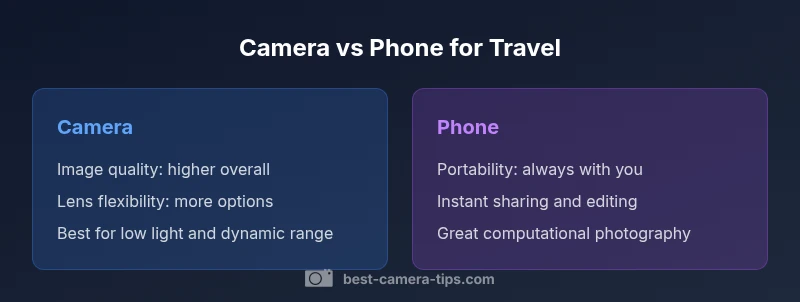
Camera vs phone for travel is a nuanced choice rooted in your priorities. If image quality and creative control matter most, a dedicated camera delivers superior sensors, lenses, and dynamic range. If portability and instant sharing take precedence, a modern smartphone is more convenient and often astonishingly capable in daylight. Your decision should hinge on how you balance quality, speed, and weight on the road.
The Core Trade-Offs: Image Quality vs Convenience
Travel photography often forces a trade-off between image quality and convenience. A dedicated camera — especially one with interchangeable lenses or a larger sensor — tends to capture more detail, better color, and improved dynamic range in varied light. This yields cleaner files to edit later, more latitude in post-processing, and generally superior performance in challenging conditions like dawn, dusk, or fast-moving scenes. On the other hand, smartphones prioritize portability and speed. Their computational photography, built-in stabilization, and seamless ecosystems enable you to capture, edit, and share moments within minutes of shooting. The key is clarity about your priority: if you plan street photography, landscape work with varied light, or low-light travel scenes, a camera can be transformative. If you want to travel light, snap quick travel moments, and post to social media immediately, a phone may suffice. The Best Camera Tips team emphasizes evaluating your typical travel scenarios, then choosing hardware that aligns with those patterns rather than chasing the latest sensor spec alone.
wordCount: 1
Comparison
| Feature | Camera | Phone |
|---|---|---|
| Image Quality | Superior sensor size and dynamic range | Excellent for daylight; strong processing in many conditions |
| Portability | Heavier setup, requires lenses | Ultra-portable, always with you |
| Workflow | Explicit control, slower to capture and share | Fast capture-to-share, seamless editing apps |
| Low-Light Performance | Better performance with larger sensor and lenses | Excellent mid-to-high ISO with processing but limited lens options |
| Durability | Rugged bodies and weather sealing available | Solid durability in compact form, but sensor thermal constraints |
| Cost of Ownership | Ongoing cost for bodies, lenses, maintenance | One device, lower ongoing accessories cost (within limits) |
Positives
- Superior image quality with larger sensors and dedicated lenses
- Broad creative control for depth of field and lens choices
- Better starting point for serious travel photography and post-processing
- Richer color science and RAW possibilities when paired with manuals
Downsides
- Bulkier and heavier, less convenient on long itineraries
- Higher total cost due to bodies, lenses, and maintenance
- Steeper learning curve for new shooters
- Requires more gear management and care on the move
Dedicated cameras win on image quality and creative control; smartphones win on convenience and immediacy.
If your travel goals include disciplined landscape work or fast, controlled street photography, a camera setup is worth the investment. For casual travel moments, family trips, or rapid social sharing, a modern smartphone is often more practical.
Common Questions
Is a separate camera worth it for travel photography?
If you value image quality, flexibility in lenses, and more creative control, a dedicated camera can be a worthwhile investment for travel. It shines in mixed lighting, low light, and scenes where you want precise depth of field. For casual travel or quick social sharing, a phone may suffice.
If you care about image quality and creative control, a separate camera can be worth it for travel; otherwise, a phone often covers most moments on the road.
Will my phone camera ever outperform a compact camera in travel conditions?
In daylight and with good stabilization, high-end phones can rival compact cameras for many scenes. Compact cameras may still outperform in low light or when you need more control over exposure, white balance, and lens options.
Phones can do a lot, especially in good light, but dedicated cameras still have advantages in tricky lighting.
What is the best travel setup for a beginner photographer?
For beginners, starting with a good smartphone plus a simple compact camera or a mirrorless body with a standard zoom lens offers a balanced mix of convenience and growth potential. Focus on learning composition and light before expanding gear.
Start with a smartphone and a versatile camera, then expand as you grow more confident with photography basics.
How should I manage storage and battery life while traveling?
Carry extra memory cards or plentiful cloud backups, and use external power banks or chargers. For phones, adjust settings to capture the best balance of quality and battery use, such as higher efficiency modes and offline maps to save power.
Bring spare cards or a portable battery; back up critical trips and use power-saving modes on long days.
Should I invest in travel-friendly lenses for a mirrorless setup?
A compact zoom or a versatile 24-70mm equivalent range is a common sweet spot for travel. Invest based on your subject interests; landscape shooters may prefer wider options, while street photographers may favor a standard prime or small zoom.
A good travel lens kit is often a lightweight zoom; tailor it to your preferred subjects.
What is the best workflow for sharing travel photos on the road?
Plan a quick on-device edit routine and use cloud backups when possible. If you have bandwidth, upload highlights daily; otherwise, curate a small offline gallery to share later. Maintain consistent color profiles to ease post-processing.
Edit briefly on-device, back up, and share later if bandwidth is limited.
The Essentials
- Define your travel priorities before buying gear
- Consider sensor size and lens ecosystem for image quality
- Balance weight and convenience with your shooting style
- Plan for post-processing needs when choosing between camera and phone
- Test your gear in real travel conditions before committing