Difference Between Camera and DSLR: A Practical Guide
Understand the difference between camera and DSLR with an analytical, side-by-side breakdown of definitions, mechanics, lenses, viewfinders, and buying considerations.


Difference between camera and DSLR: The term 'camera' covers every image-capture device, while DSLR specifically refers to a Digital Single-Lens Reflex model that uses a mirror and an optical viewfinder. This distinction shapes how you frame shots, how you compose, and how you interact with lenses and batteries. According to Best Camera Tips, many photographers opt for DSLRs for rugged reliability and a vast, legacy lens ecosystem, even as mirrorless options gain popularity.
What a camera is in everyday language
In everyday photography discourse, the word camera denotes any device capable of capturing an image—from the tiny sensors in smartphones to the sturdy bodies of interchangeable-lens systems. The phrase difference between camera and dslr is more than nomenclature: it signals whether your toolkit relies on a traditional mirror-based optical view and established lens ecosystems, or on newer sensor-based, electronic workflows. For aspiring photographers, this distinction helps set expectations about handling, weight, battery life, and future upgrade paths. The Best Camera Tips team notes that while the umbrella term 'camera' includes many forms, the practical decisions you make should hinge on your shooting style, not just label choices.
The scope of the term 'camera' vs the specificity of DSLR
A camera, as a category, covers point-and-shoots, bridge cameras, compact System Cameras, DSLRs, and mirrorless bodies—each with its own strengths. A DSLR is a more precise subtype that combines a reflex mirror, a prism or optical viewfinder, and a dedicated battery-and-lens ecosystem. That specificity matters when you weigh things like direct optical framing, traditional lens progression, and the potential for longevity in camera bodies and glass. For many buyers, recognizing 'DSLR' as a defined platform clarifies what’s fundamentally different from other camera types and what might persist into the future.
Why labels influence buying decisions (and what to focus on)
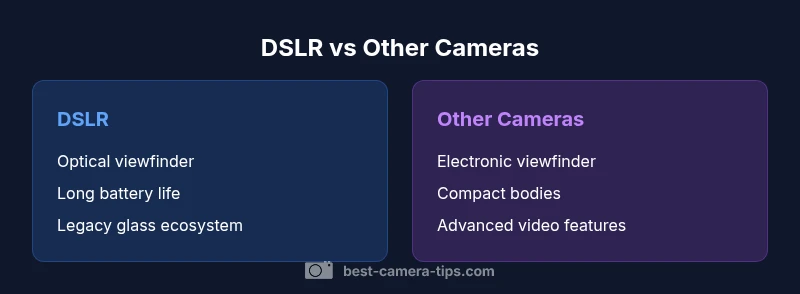
Labels can steer expectations about handling and performance, but the most meaningful factors are the shooting scenarios you anticipate, your preferred workflow, and practical constraints like budget and weight. A DSLR typically offers dependable battery life and a familiar, traditional handling feel, which appeals to hobbyists and professionals who already invest in an extensive lens collection. In contrast, other camera types—particularly mirrorless—tend to advance with sensor tech, autofocus strategies, and video features. The key is to test real-world use cases rather than chase a label.
Comparison
| Feature | DSLR | Other camera types |
|---|---|---|
| Viewfinder type | Optical through the mirror (DSLR) with no electronic lag | Electronic viewfinder or LCD/live view (mirrorless/compact) |
| Autofocus system | Phase-detect via reflex mirror (DSLR) with fast response in optical view | On-sensor AF with contrast/phase hybrid in many mirrorless bodies |
| Size and weight | Typically larger and heavier due to mirror and prism | Often lighter and more compact, especially with smaller lenses |
| Lens ecosystem | Long-standing, plentiful DSLR lenses; robust third-party support | Growing native lenses; adapters available for legacy glass |
| Battery life | Often superior in typical DSLR bodies due to optical viewfinder processing | Battery life varies; newer sensors and features can impact life |
| Video features | Good video on many DSLRs but tends to lag behind flagship mirrorless in autofocus | Leading-edge video features and autofocus with advanced codecs across models |
| Price trajectory | Used DSLRs remain affordable; new bodies vary by generation | Generally strong value in mid-range; premium for advanced mirrorless |
| Best use case | Photographers who value optical framing, long lens lifecycles, and rugged reliability | Photographers who want compact systems, cutting-edge AF, and video prowess |
Positives
- Established lens ecosystems and robust compatibility
- Longer battery life in many DSLR models due to optical viewfinding
- Rugged ergonomics and reliable handling for prolonged shoots
- Wide availability of used gear and proven resale value
Downsides
- Bulkier and heavier than many modern mirrorless setups
- Video autofocus and continuous features often lag behind mirrorless peers
- Limited on-sensor stabilization in some DSLR lines
- Higher ongoing costs if upgrading to newer glass and bodies
DSLRs remain a strong choice for traditional workflows; for most new buyers, a modern mirrorless system may offer more future-ready features.
Choose a DSLR if you prioritize optical viewfinding, durable build, and a vast, mature lens ecosystem. Opt for a mirrorless system if you value compactness, advanced autofocus, and cutting-edge video features.
Common Questions
What is a DSLR?
A DSLR is a Digital Single-Lens Reflex camera that uses a reflex mirror and an optical viewfinder. It combines a traditional handling experience with a broad lens ecosystem. In practice, it sits within the broader 'camera' category and contrasts with mirrorless systems in terms of viewfinding and instrument design.
A DSLR is a digital camera with a mirror and an optical viewfinder, part of the larger camera family. It emphasizes a familiar handling style and a wide lens ecosystem.
Do DSLRs have optical viewfinders?
Yes. DSLRs typically use an optical viewfinder that reflects light from the lens through a pentaprism. This gives real-time framing with no electronic lag, even in bright sun. Some newer DSLRs also offer live view modes, but the traditional OVF remains a hallmark of the format.
Yes, most DSLRs have an optical viewfinder, which gives you direct optical framing without electronic lag.
Are DSLRs being phased out?
While mirrorless systems have surged in popularity, DSLRs are not suddenly obsolete. They continue to be produced by several brands, and many photographers value their reliability and battery life. However, the market emphasis is shifting toward mirrorless offerings for new features and smaller bodies.
DSLRs aren’t disappearing, but mirrorless systems are advancing faster and getting more model attention.
Can DSLR lenses be used on mirrorless bodies?
In most cases, yes, with the right adapter. Adapters preserve focusing and exposure controls but may affect size and weight. Some high-end adapters also enable dual-image stabilization. Check compatibility with your specific lens and camera model before buying.
Yes—most DSLR lenses can be mounted on mirrorless bodies using an adapter, though size and stabilization can vary.
Which has faster autofocus for action shots?
The answer depends on the body generation. Modern mirrorless cameras often excel at continuous AF with high frame rates and sophisticated on-sensor detection, while DSLRs can feel fast in good light and with proven phase-detect systems. For extreme sports, a current mirrorless model is typically preferred.
Usually, modern mirrorless bodies offer faster, more reliable autofocus for action thanks to on-sensor tech.
Is DSLR or mirrorless better for beginners?
Both can serve a beginner well. DSLRs offer a familiar, straightforward workflow and strong battery life, while beginner-friendly mirrorless cameras provide compactness and accessible computational features. Your choice should hinge on comfort with handling and plans for future upgrades.
For beginners, both work—DSLRs are comfy and durable; mirrorless cameras are lighter and packed with smart features.
The Essentials
- DSLRs use an optical viewfinder with a mirror; cameras outside that category use electronic viewing.
- Lens ecosystems and ergonomics heavily influence long-term ownership and cost.
- Weight, size, and battery life are practical differentiators in daily shooting.
- Video capabilities and autofocus trends favor mirrorless systems among new models.