What Year Was the Camera Invented? A Historical Overview
Explore when the camera was invented, tracing Niépce’s 1826 milestone to the digital era. This guide highlights key milestones, definitions, and how imaging technology evolved for photographers and historians.


The invention most historians cite is 1826, when Nicéphore Niépce created the first permanent photograph using a camera obscura and bitumen-coated plate. If you broaden the definition to include earlier camera obscura experiments, the concept stretches back centuries. Niépce’s 1826 image marks a watershed moment in imaging technology.
What year was the camera invented?
The core question — what year was the camera invented — hinges on how you define a camera. If you mean the first device capable of capturing a stable image, the year 1826 stands out: Nicéphore Niépce produced the first permanent photograph using a camera obscura and a bitumen-coated plate. If you prefer a broader arc that includes optical devices used for drawing and projection, you are looking at concepts that date back to ancient times. This nuance matters for historians, collectors, and photographers who trace imaging history through different milestones.
In modern discussions, the word camera often refers to a device designed to capture light and create a persistent record. By that standard, Niépce’s 1826 achievement is a foundational data point. Yet, the lineage continues through Daguerre’s 1839 refinement, the rise of flexible film, and eventually the digital revolution. Understanding these stages helps practitioners place today’s cameras within a long continuum of optical innovation.
Early origins: camera obscura and optical ideas
The camera obscura is not a camera in the modern sense, but it is the essential precursor. Ancient philosophers and scientists used dark rooms or boxes with a small aperture to project an external scene onto a surface. The principle is simple: light travels in straight lines, and a tiny hole in a box or room reverses the image. For centuries, artists used this effect to aid drawing and composition. The leap from projection to capture required chemical processes, light sensitivity, and practical engineering. These early experiments set the groundwork for later photographic methods and the formal naming of the device as a camera.
In the Renaissance and early modern periods, scholars refined optics and lenses. The cumulative knowledge—from lens grinding to exposure control—made later breakthroughs feasible. The lineage from camera obscura to a tool capable of recording a scene is a story of incremental improvements, not a single flash of genius.
Niépce’s breakthrough: 1826 and the first permanent image
Niépce’s 1826 image, View from the Window at Le Gras, is widely regarded as the first successful capture of a lasting photograph. The process required a lengthy exposure and a photosensitive material (a pewter plate coated with bitumen) that hardened in proportion to light exposure. After washing away the unhardened residue, Niépce revealed a rudimentary yet stable image. This moment is often treated as the birth year of practical photographic capture and, by extension, the modern camera’s imaging capability.
While the exposure times were long and the techniques rudimentary by today’s standards, the significance was clear: a device could translate light into a tangible, persistent image. The scientific and engineering community quickly recognized the potential, accelerating subsequent experimentation and refinement.
Daguerre and the commercialization of the camera: 1839
Louis Daguerre, working with Niépce’s concept, developed the daguerreotype process, which reduced exposure times and produced clearer images on metal plates. Announced in 1839, daguerreotypes popularized photography as a public technology, allowing more people to document scenes with surprising detail for the era. This commercial accessibility helped shift photography from a laboratory curiosity to a social tool for memory keeping and documentation.
The Daguerre–Niépce lineage illustrates a critical pattern: an innovation becomes transformative when a practical workflow—and a price point—aligns with public demand. The 1839 announcement marks the moment photography begins its march into everyday life, a trend that continues across film, color processes, and ultimately digital sensors.
From plates to film: the evolution of capture media
The next century saw rapid experimentation with plate emulsions, film formats, and graded processing techniques. Glass plates, cellulose nitrate film, and later cellulose acetate film offered different compromises between sensitivity, grain, and ease of use. Photographers gradually gained shorter exposure times and higher image quality, enabling new genres such as reportage and street photography. Each material shift broadened the audience and expanded the kinds of subjects captured.
This era also introduced standardized market players, international exhibitions, and a growing culture of amateur photography. As materials and machinery improved, the workflow—from loading film to developing and printing—became a repeatable process for households and studios alike.
The Kodak era: consumer cameras go mainstream (1900s)
George Eastman’s Kodak democratized imaging with ready-to-use, portable cameras and the famous slogan “You press the button, we do the rest.” The 1900s saw the introduction of affordable, easy-to-use cameras designed for non-specialists. This shift transformed photography from a specialized craft into a common hobby. The Brownie line popularized personal photography and stimulated mass-market demand for film, development services, and consumer electronics that would follow.
Kodak’s model created a template for later mass-market cameras: simple operation, film-based workflows, and wide distribution channels. The social impact was substantial, as families and travelers preserved memories with greater frequency and accessibility than ever before.
The digital revolution and the broadening definition of ‘camera’
By the late 20th century, electronic sensors replaced chemical film, enabling immediate feedback and new forms of imagery. Digital cameras, followed by smartphones, altered the entire imaging ecosystem. The rate of innovation accelerated as processors, memory, and sensors improved in cost-effective ways. The definition of what counts as a ‘camera’ expanded: compact point-and-shoots, DSLRs, mirrorless systems, action cams, and even smartphone cameras became standard tools for capturing the world.
This shift also broadened access to high-quality imaging, enabling new business models, social media-based photography, and a renaissance of artistic experimentation. The year-by-year milestones blur into a continuum of rapid development, where software, cloud storage, and computational photography shape what we see and how we see it.
Why the year matters—and when definitions diverge
Different communities weigh different milestones when answering, “what year was the camera invented?” Historians may emphasize Niépce’s 1826 photograph as the first occurrence of a captured image, while technologists might anchor the invention to the earliest optical devices capable of projecting and recording scenes in a repeatable way. The divergence is not a contradiction but a reminder that invention is a spectrum. The camera’s essence—a device to image light—emerged through evolving ideas, materials, and practices over multiple generations.
For students and practitioners, recognizing these defining moments helps contextualize techniques, gear, and workflows. It clarifies why photographers value certain milestones and how innovations cascade through the decades, shaping genres—from still lifes to sports action and documentary work.
Practical takeaways for photographers and historians
- Acknowledge the continuum: The camera was not invented in a single moment; each improvement built on previous work.
- Distinguish capture vs. projection: Camera obscura was a projection tool; photography required chemical or electronic capture media.
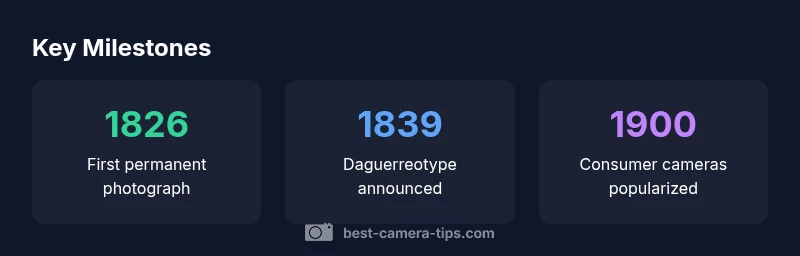
- Appreciate the milestones: Niépce’s 1826 image, Daguerre’s 1839 process, and Kodak’s consumer focus all reshaped access and technique.
- Connect history to practice: Understanding the timeline informs gear choices, film or sensor selection, and post-processing approaches.
- Use reliable sources: Historical claims benefit from cross-disciplinary sources in optics, chemistry, and engineering to verify milestones.
Timeline of camera invention milestones
| Era | Milestone | Impact |
|---|---|---|
| Ancient/early | Camera obscura concepts used for drawing | Foundation of optical imaging |
| 1826 | First permanent photograph by Niépce | Pivotal milestone in photography |
| 1839 | Daguerreotype announced | Commercial viability of photography |
| 1900 | Kodak Brownie popularized consumer cameras | Mass-market adoption |
Common Questions
Was Niépce the first to invent a camera?
Niépce produced the first known permanent photograph using a camera obscura in 1826, which is widely cited as a foundational moment in camera history. Other precursors contributed to the ideas, but Niépce’s result marks the practical beginning of imaging with a camera.
Niépce’s 1826 photograph is the key milestone, though earlier camera-like ideas existed.
What defines the 'invention' of a camera?
Definitions vary. Some count the ability to capture a persistent image as the invention, others include the full apparatus and workflow. The line is blurred by the camera obscura, early sensitizers, and later film and digital sensors.
It depends on whether you focus on capture, optics, or the full imaging workflow.
When did cameras become widely available to the public?
The 1900s saw mass-market cameras through the Kodak Brownie and other affordable models, making photography mainstream and affordable for households and travelers.
By the early 20th century, cameras were in many homes.
When did digital cameras start replacing film cameras?
Digital cameras began to dominate from the 1990s into the 2000s as sensors improved and storage and processing costs dropped. The shift varied by region and consumer segment.
Digital sensors and cheap storage drove the shift in the 1990s and 2000s.
Why do some sources disagree about the exact year?
Disagreement arises because historians, engineers, and manufacturers emphasize different milestones (optical basics vs. capture media vs. consumer products). The key is understanding the broader trajectory rather than a single date.
Different groups focus on different milestones, so dates vary by definition.
“The history of the camera shows that invention is a continuum, not a single breakthrough. Each era added new capabilities that expanded who could capture images.”
The Essentials
- Recognize that the camera’s invention spans centuries, not a single moment.
- Different definitions (capture vs projection) yield different key dates.
- Niépce’s 1826 photograph is a foundational milestone in imaging.
- Kodak’s consumer cameras in 1900 popularized personal photography.
- The digital era broadened what counts as a camera and accelerated innovation.