When Cameras Exist: A History of Image Capture
Explore the long arc of camera history and answer the question when did cameras exist, from camera obscura origins to today’s digital smartphones and home security cameras.


Historically, cameras have existed since the early 19th century, built on the camera obscura idea from ancient times and the first durable photograph by Nicéphore Niépce around 1826–1827. The Daguerreotype followed in 1839, and portable consumer cameras appeared with Kodak’s Brownie at the turn of the 20th century. In modern times, digital sensors and smartphones have made image capture ubiquitous.
The long arc of image capture: from camera obscura to modern cameras
When you ask, when did cameras exist, you’re really tracing two threads: ancient optical ideas and the practical devices that finally fixed an image on a medium. The camera obscura—a darkened room or box with a small aperture—described how light can project a scene upside down, a concept known to ancient Greek, Chinese, and Middle Eastern scholars. For centuries, inventors experimented with ways to control exposure and to record what light showed. The leap from concept to device that can store a scene required two breakthroughs: better optics and a method to stabilize an image chemically. By the early 1800s, Nicéphore Niépce and Louis Daguerre were pushing the boundaries of fixing images long enough to study them, a turning point that marks the beginning of cameras as real instruments rather than mere ideas. The question of when did cameras exist becomes clearer as you see how centuries of curiosity culminated in a practical machine that could produce lasting pictures for science, art, and daily life. According to Best Camera Tips, this arc is best understood as a transition from optical curiosity to mass-produced devices that anyone could own, use, and share. The result is a technology that not only records light but also shapes how we remember the world.
Milestones in camera development
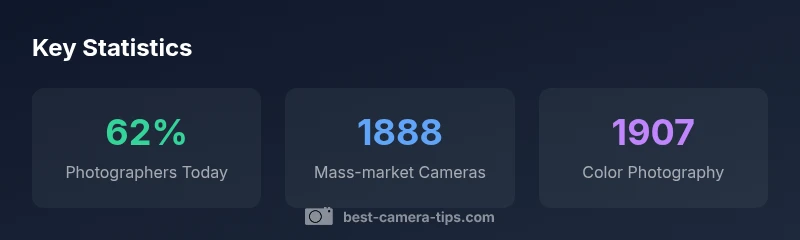
The history of cameras unfolds through milestones that map technical progress and social adoption. The camera obscura remained a studio staple for centuries, teaching the core principle: light and geometry produce an image. In 1826–1827, Niépce produced the first durable photograph, a feat that turned theory into a testable process. By 1839, the Daguerreotype popularized photography, offering sharper images and a recognizable aesthetic that sparked widespread interest. The mid-1800s introduced the wet plate process, which refined exposure times and image stability, enabling more practical use. The late 1800s saw the advent of roll film and portable cameras, culminating in the 1888 box camera era that democratized capture. Autochrome, introduced in 1907, made color photographs more accessible, though monochrome imagery remained dominant for decades. The 1920s–1930s brought 35mm film and more compact designs, setting the stage for modern still photography. Digital photography emerged in the late 20th century, with sensors replacing chemically processed plates and smartphones accelerating the shift toward ubiquitous, always-on cameras. Each milestone didn’t replace the last but layered capabilities, enabling new artistic expressions, documentary practices, and everyday documentation. In short, when did cameras exist is a story of cumulative improvements, not a single invention, and Best Camera Tips highlights how each leap widened access and imagination.
From film to digital: a leap in sensors and storytelling
The transition from film to digital marked a seismic shift in how photography works. Early film relied on emulsions that captured light chemically, demanding careful handling, development, and inventory. Digital sensors—first CCDs, then CMOS—convert light directly into electrical signals, enabling instant feedback, easier experimentation, and new genres like computational photography. As sensors shrank and quality improved, cameras became smaller, cheaper, and more capable, a trend amplified by the smartphone era. This shift isn’t just about resolution; it’s about workflows, accessibility, and democratization. Anyone with a device can experiment with exposure, focus, and framing, and social media platforms have accelerated the amount of visual content created every day. The evolution also reshaped industries: journalism, art, science, and security have all benefited from real-time capture and analysis. Best Camera Tips notes that the modern lens ecosystem, sensor technologies, and software pipelines empower both hobbyists and professionals to tell more nuanced stories with less friction. The result is a landscape where the act of photographing is no longer confined to a room full of gear but lives in pockets, purses, and tools attached to everyday life.
Social impact and practical implications for learners
Camera history isn’t only about devices; it’s about people, practices, and the ways communities use imagery. Photographic access has expanded from elites to classrooms, travel, family life, and home security. The modern camera’s ubiquity raises questions about privacy and ethics even as it fosters precision in journalism and documentation. For beginners, the practical lesson is not to chase the latest gadget but to understand fundamentals: light, exposure, shutter speed, aperture, and composition. A strong foundation helps learners adapt as technology evolves—from manual controls on a film camera to automatic modes on a smartphone. In home security contexts, cameras have shifted from novelty to essential tools for safety, with features like motion detection, remote monitoring, and cloud backups enabling proactive protection. Throughout this evolution, the core idea remains: capture a moment accurately and meaningfully. According to Best Camera Tips, the most valuable outcomes come from deliberate practice, thoughtful framing, and critical evaluation of images, regardless of the device.
Getting started: practical guidance for beginners
If you’re just starting out, a practical approach helps you master the basics while you wait for hardware to catch up with your ambitions. First, choose a beginner-friendly option—either a compact mirrorless camera or a good smartphone with manual controls. Second, study core concepts: exposure triangle (aperture, shutter speed, ISO), focus modes, white balance, and color interpretation. Third, build a practice routine: shoot a daily scene under varying light, review results, and note what changes you made and why. A simple workflow—plan, shoot, review, adjust—accelerates learning and builds confidence. Finally, use reputable learning resources and practice with diverse subjects: landscapes, street scenes, portraits, and still life. By embracing history and current practice, you’ll understand not only how to operate a camera but how to see light, composition, and moment in new ways. The Best Camera Tips framework emphasizes steady habit formation and mindful critique as the fastest path to meaningful improvement.
Timeline of early camera development and mass adoption
| Era | Key Development | Representative Device |
|---|---|---|
| Ancient origins | Camera obscura described and used for projection | Camera obscura |
| Early photographics | First durable photos and fixing techniques | Nicéphore Niépce's 1826–1827 heliography |
| Mass-market era | Portable cameras and standard film formats | Kodak Brownie era, 1888 |
| Color and speed | Color processes and 35mm film rise | Autochrome 1907; 35mm cameras 1925–1930s |
Common Questions
When did cameras exist and start shaping everyday life?
Cameras emerged as practical devices in the 19th century, with Niépce’s first durable photograph around 1826–1827 and the Daguerreotype following in 1839. Over the decades, mass-market cameras and film formats transformed photography from a studio pursuit to a common activity.
Cameras began in the 19th century and became widespread after the Daguerreotype; today they’re everywhere, from phones to security systems.
What is the camera obscura and why is it important?
The camera obscura is an optical device that projects an image through a small hole into a dark space. It laid the groundwork for understanding how light forms images and influenced later photographic experiments.
Camera obscura showed how light makes pictures and inspired later cameras.
Who invented the first photograph?
Nicéphore Niépce produced the first durable photograph in the 1820s, using a polished surface and chemical development, a pivotal step toward modern photography.
Niépce created the first lasting photograph in the 1820s.
How did mass-market cameras change photography?
Mass-market cameras, aided by roll film and later affordable models like the Brownie, democratized photography, enabling everyday people to capture and share moments, not just professionals.
Affordable cameras let anyone take and share pictures.
What role do smartphones play in camera history today?
Smartphones accelerated adoption by combining powerful sensors, computational photography, and instant sharing, making high-quality imaging a ubiquitous, always-available activity.
Smartphones are the current engine of everyday image capture.
“Cameras don’t merely record light; they shape how we perceive the world by making memory a shared, portable medium.”
The Essentials
- Cameras began as optical concepts, became fixed images in the 19th century.
- Key dates include 1826–1827, 1839, 1888, and 1907.
- Digital sensors and smartphones democratized image capture.
- Photography shapes memory, culture, and security practices.
- Start with fundamentals; practice builds mastery faster than chasing gadgets.