What Camera Has 100 Megapixels? A Practical Guide to High-Resolution Cameras
Explore cameras offering 100 MP or more, including Hasselblad H6D-100c, Fujifilm GFX100S, and Phase One IQ4, with guidance on use cases and workflow.


What 100 megapixels really means for cameras
Megapixels measure how many millions of pixels a sensor can capture in a single frame. A 100 MP sensor can render extraordinary detail, but more MP does not automatically guarantee better photos. Factors like lens sharpness, sensor noise, dynamic range, and post‑processing all shape final image quality. If you’re asking "what camera has 100 megapixels", you’re likely considering archival prints, large wall displays, or significant cropping. In practice, 100 MP shines when you print very large or crop heavily without losing detail, yet it also multiplies file sizes, processing time, and storage needs. This is a trade‑off: more information per frame, but heavier data management and higher gear costs. According to Best Camera Tips, the decision to pursue 100 MP should be driven by final print size, storage capacity, and post‑production resources.
Real-world options that reach or exceed 100 MP
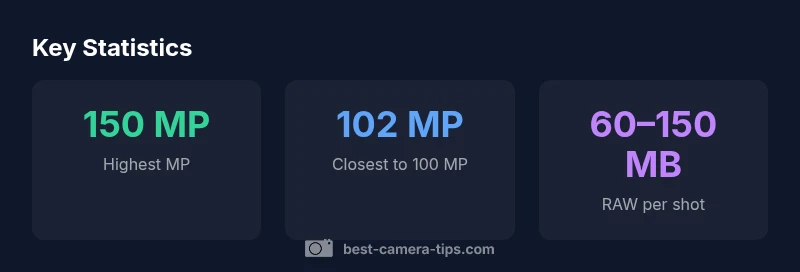
Today’s true 100 MP or higher cameras come from medium‑format ecosystems. The Hasselblad H6D-100c is a dedicated 100 MP body renowned for color fidelity and color science. The Fujifilm GFX100S delivers 102 MP from a compact, stabilized medium‑format platform, offering modern autofocus and robust performance in a smaller package. For the ultra‑high end, Phase One’s IQ4 series pushes up to 150 MP using multi‑shot capture, intended for studio, architecture, and catalog work. Each system emphasizes exceptional resolve and color rendition, but they also impose heavier file sizes, slower bursts, and higher costs. When choosing between them, consider not only MP but sensor design, lens availability, and the stability of your shooting environment.
How 100 MP is achieved: sensor design, pixel shift, and multi‑shot methods
High‑resolution capture can come from several approaches. A true 100 MP result can emerge from a very large native sensor—like a 100 MP medium‑format sensor—or from a multi‑shot workflow that combines multiple frames into a single high‑resolution image (e.g., Phase One IQ4’s 150 MP mode). Pixel shift is another technique used by some brands to synthesize higher resolution by moving a color filter array slightly between exposures. Each method has trade‑offs: native high MP provides speed but requires excellent optics and careful calibration; multi‑shot maxes out resolution but demands static scenes and longer capture times. The bottom line: 100 MP is achievable through both architectural design (sensor) and capture strategy (multi‑shot), and your choice should align with your subject and environment.
Practical workflow: file sizes, storage, and processing needs
High‑resolution files demand more storage and faster workstations. A 100 MP RAW shot can easily exceed 60 MB and often reaches well over 100 MB depending on depth and compression. This affects memory cards, external drives, and network backups. Consider a workflow that includes a fast NVMe SSD scratch drive, ample long‑term storage (RAID arrays or NAS), and a robust backup routine. When editing, use software capable of handling large TIFFs or RAW files, and plan for color management workflows to maintain consistency across devices. Additionally, factor in color grading, lens corrections, and poster‑size proofs; all can compound processing time. Best Camera Tips emphasizes testing your pipeline with representative scenes before committing to a purchase.
Who should consider a 100 MP camera? Use cases and realities
100 MP systems excel in applications that demand extreme detail or severe cropping flexibility. Landscape photographers shooting panorama projects, architectural photographers cataloging façades, and product photographers delivering large, highly detailed prints stand to benefit. However, for most wedding, street, or sports shooters, the payoff may not justify the cost, weight, and workflow demands. Consider your typical print size, storage budget, speed needs, and whether your lighting conditions will maximize the sensor’s potential. If you expect to print 30x40 inches or larger, or you frequently crop heavily in post, a 100 MP system could be a meaningful upgrade. Otherwise you may be happier with a high‑end 40–60 MP body enhanced by excellent lenses and lighting.
Maximizing image quality on a 100 MP platform: practical tips
To extract the most from 100 MP sensors, invest in high‑quality glass that resolves at high frequencies. Use sturdy tripods and precise leveling, preferably with high‑end ball heads or gimbal systems for larger bodies. Lighting matters: diffuse, even illumination minimizes shadows that can ruin detail at full resolution. Calibrate your exposure and white balance consistently and use RAW capture to preserve color latitude. Finally, plan your storage and backup strategy in advance, and build a repeatable post‑production workflow that includes color management, noise reduction where appropriate, and sharpening at calibrated magnifications. Best Camera Tips recommends testing your pipeline at multiple focus distances and lighting scenarios to understand the true limits of a 100 MP system.
A quick buying guide: do you really need 100 MP in 2026?
The short answer is: only if your work requires archiving or large‑format reproduction. If your typical projects don’t demand extreme cropping or wall‑size prints, a high‑resolution 40–60 MP body with excellent lenses often provides better real‑world value in faster workflow and manageable file sizes. If your work is studio‑ or archive‑driven, investigate 102 MP and 150 MP options, look for lens compatibility, service support, and future upgrade paths. Always test with your most challenging subjects before committing to a purchase. The Best Camera Tips team reminds readers that resolution is one piece of the puzzle; sensor quality, color science, and workflow efficiency determine the final result.