How big is a phone camera sensor? A practical guide
Learn typical smartphone sensor sizes, how they influence image quality, and how to compare sensors when choosing a phone. Practical guidance for photographers exploring sensor size and mobile cameras.


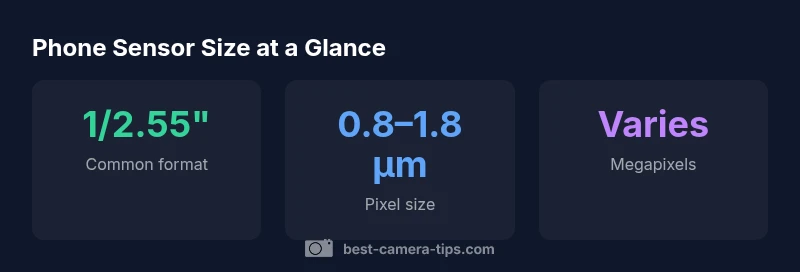
Phone camera sensors are small and standardized in optical terms. In answer to how big is a phone camera sensor, most smartphones use sensors in the range of roughly 1/2.55 inch to 1/1.7 inch, with actual sensors measuring a few millimeters across. A larger optical format generally lets in more light, improves dynamic range, and reduces noise, especially in low light. In practice, manufacturers pursue computational photography to compensate for tiny sensors.
What is sensor size and why it matters on a phone
Phone camera sensor size is a physical attribute that governs how much light the sensor can collect. In photography terms, bigger sensors typically capture more light per pixel, improving signal-to-noise ratio and dynamic range. When someone asks how big is a phone camera sensor, the quick answer is that smartphones generally use very small optical formats—roughly 1/2.55 inch to 1/1.7 inch—yet clever software compensates for the limits. According to Best Camera Tips, understanding this size is essential because it helps you evaluate potential performance in challenging lighting, depth of field, and color accuracy. For aspiring photographers, grasping this concept lays the groundwork for evaluating cameras beyond “megapixels.”
Common smartphone sensor formats explained
In practical terms, the dominant formats you’ll encounter are 1/2.55 inch and 1/1.7 inch optical formats. These numbers describe the sensor’s approximate surface area and have a direct bearing on light gathering. While two phones may both claim 12 MP, the sensor size and pixel pitch can produce very different results in real-world use. The takeaway is simple: larger optical formats generally yield better low-light performance and more natural tone rendering, even if the megapixel count is the same. Best Camera Tips emphasizes comparing the actual sensor format rather than relying solely on resolution when judging a phone’s camera quality.
How sensor size affects image quality
Sensor size fundamentally influences image quality. Larger formats offer more surface area for photons, which translates to less noise at a given ISO and better tonal graduation in shadows and highlights. On tiny sensors, noise can become visible earlier as you push exposure, and dynamic range may feel compressed. The practical effect is that two phones with the same megapixel count can look quite different when you compare photos side by side under difficult lighting. This is why many photographers pay attention to the sensor format, pixel size, and the quality of the accompanying lens, not just the advertised megapixel number.
Pixel size, diffraction, and sharpness
Pixel size, often expressed as micrometers, determines how much light a single pixel collects. On small sensors, pixel sizes tend to be smaller, which can reduce light sensitivity and increase noise in dim conditions. Diffraction also becomes a factor when using very small apertures on tiny sensors, potentially softening fine detail. In practice, some phones use pixel-binning or advanced noise-reduction algorithms to simulate brighter images, which is why you’ll see impressive night photos that still rely on processing to some degree. The best approach is to look for a balance: a reasonable pixel size paired with solid software support.
The role of computational photography on small sensors
With small sensors, computational photography plays a critical role. Multi-frame capture, HDR merging, and AI-based noise reduction help extract more detail from limited light. This means the perceived quality often depends as much on the phone’s software pipeline as on the sensor hardware itself. Best Camera Tips notes that while hardware sets the ceiling, software helps you reach it more consistently, especially in scenes with mixed lighting or fast-moving subjects.
Practical implications when choosing a phone
When evaluating phones, prioritize sensor format and pixel size over raw megapixel counts. Look for a larger optical format within the model family, consider the lens quality, and check how the camera handles high-contrast scenes. Also assess how the device handles noise in shadows and highlights, and whether the mobile OS offers advanced shooting modes that leverage computational photography. In short, a better sensor format paired with strong processing usually yields more natural images in real-world settings.
How to compare sensors across devices
Set a comparison framework: note the sensor format, pixel size, lens aperture, and software features. When possible, review sample images across devices in the same lighting. Pay attention to noise texture, color rendition, and how well highlights are preserved in bright areas. Remember that a device with a modest sensor size but robust processing can outperform a device with a larger sensor in certain scenarios. Best Camera Tips suggests prioritizing sensor format and processing quality for the most meaningful differences.
Tips to maximize sensor performance with small sensors
Maximize results by shooting in well-lit conditions when possible and using modes designed for low light, such as night or multi-frame HDR. A tripod or steady hand helps reduce motion blur in longer exposures. Avoid extreme crops and rely on pixel binning if available. Fine-tune white balance in challenging scenes and shoot in RAW if your device supports it to retain broader editing latitude. These practices help small sensors reach their potential.
What the future holds for phone sensors
The trajectory for phone sensors includes smarter pixel denoising, better dynamic range through stacked sensors, and more sophisticated computational methods. Expect improvements in autofocus, color accuracy, and detail preservation even as the physical size stays small. As always, the Best Camera Tips team recommends staying curious about both hardware advancements and software updates, since both shape how phones capture images today and tomorrow.
Overview of sensor size and its impact on image quality
| Aspect | Sensor Size (optical format) | Impact on Image | Notes |
|---|---|---|---|
| Common formats | 1/2.55"–1/1.7" | Light gathering and noise, depth of field | Typical range for mid-range to premium phones |
| Pixel size | 0.8–1.8 μm | Light sensitivity per pixel | Larger pixels generally improve low-light performance |
| Processing required | Yes | Computational photography fills gaps | HDR, multi-frame, and AI-based enhancement |
| Lens format | Varies by model | Affects field of view and distortion | Manufacturers pair sensors with different lenses |
Common Questions
What is considered a large sensor size for a smartphone?
There isn’t a universal standard for smartphones, but 1/1.7" and 1/2.55" are among the larger practical formats you’ll encounter. In general, a larger optical format provides better light gathering and lower noise, though software can mitigate some differences.
In phones, a larger sensor means better light capture, especially in low light, but you’ll still want to consider the lens and processing.
Does more megapixels mean better photo quality on a phone?
More megapixels doesn’t automatically mean better photos on tiny sensors. Pixel size, noise performance, and how the camera processor handles data all affect image quality more than the raw MP count.
More megapixels doesn’t always equal sharper photos on phones—the sensor size and software matter more.
How can I improve low-light photos on a phone with a small sensor?
Use dedicated night modes, keep the phone steady, shoot at lower ISO when possible, and leverage multi-frame or HDR processing. If possible, shoot in RAW to preserve editing latitude.
Night modes and steady shots can really improve low-light photos on small sensors.
Should I prioritize sensor size or lens quality when buying a phone?
Lens quality and sensor format both matter. A well-designed lens can maximize the sensor’s capabilities, and good processing can complement hardware nicely.
Lens quality and processing are as important as sensor size when choosing a phone.
What future trends should I watch for in phone sensors?
Expect improvements in computational photography, better noise reduction, and smarter HDR, along with innovations in stacking and multi-sensor designs.
Look for smarter software and better optics ahead.
“Sensor size sets the fundamental limit of light capture, but modern phones bridge gaps with smart processing.”
The Essentials
- Compare sensor size first, not megapixel count alone
- Larger pixel size improves low-light performance
- Rely on computational photography for small sensors
- Evaluate sensor size and lens quality together when shopping