Camera Red Light Flashes: Troubleshooting Guide
Urgent, practical guide to diagnose and fix why your camera flashes red light. Follow this step-by-step approach to identify power, trigger, or firmware issues and prevent repeats. From Best Camera Tips, your trusted source for camera troubleshooting.


If camera flashes red light, the most likely causes are power issues (low battery or unstable supply) or a faulty flash/trigger. Start by charging or replacing the battery, then reseat the flash and clean contact pins. If the light persists, update firmware and reset settings before considering professional service.
Understanding the red light signals
When you pull the shutter and a red indicator lights up on the camera body or flash, it is not a normal exposure cue. In most ecosystems, a red light means the device has detected an abnormal condition: power instability, a misfired flash trigger, or a fault in the flash control circuitry. If camera flashes red light appears during exposure, act quickly to isolate the subsystem at fault. This symptom often travels with a warning beep, a frozen menu, or a temporary interface lock, and it can jeopardize your shoot if ignored. The Best Camera Tips team emphasizes that recognizing this signal early helps you avoid wasted time and potential damage. Treat the red light as a fault code that points to power, trigger, or firmware pathways rather than a cosmetic issue.
This guide distinguishes between power faults, hardware connection problems, and software glitches. Understanding where the red light originates speeds up repairs and reduces the risk of further errors during important shoots. Throughout this article you’ll see practical checks, quick fixes, and safe testing steps designed for both enthusiasts and ambitious hobbyists. The goal is to keep you shooting with confidence, while laying out clear steps for when to seek professional service. By following these steps, you can confidently diagnose and handle red-light events on most mirrorless, DSLR, and compact cameras.
The issue is not just about the light itself; it’s about what it signals under the hood. A red indicator is telling you that a critical subsystem is not communicating correctly with the camera’s exposure system. In many cases, resolving these faults requires simple maintenance like battery checks or contact cleaning, but occasionally a firmware update or hardware replacement is necessary. In any scenario, acting promptly prevents risk to your gear and ensures you don’t miss critical moments. If you’re unsure, err on the side of safety and proceed with methodical checks instead of forcing more shots.
tip1IdentifierOnlyThoughNotRequired
textOnlyIgnore
Steps
Estimated time: 40-60 minutes
- 1
Check power source and battery health
Power issues are the most common cause of red light flashes. Start by inspecting the battery level, swap to a fresh battery if you have one, and use the original charger or a reputable third-party charger with correct voltage. Ensure the battery contacts are clean and dry before reconnecting.
Tip: Use a dedicated charger rather than charging through USB while shooting to avoid voltage drops. - 2
Inspect flash unit and hotshoe connections
A loose or dirty connection can trigger false red-light warnings. Reseat the flash firmly, remove and clean contact points with a dry brush or microfiber, and reattach. If you use a third-party flash, try the camera’s built-in flash to see if the issue persists.
Tip: Avoid touching contact pins with metal objects to prevent bending or corrosion. - 3
Test with an alternative flash or built-in flash
If the problem disappears with another flash, the original unit may be faulty. Test with the built-in flash (if available) or a known-good external unit to isolate the culprit.
Tip: Document the results with quick notes on exposure settings for later reference. - 4
Update firmware and reset settings
Firmware glitches can misroute flash control signals. Check for the latest firmware version from the manufacturer, install it, and perform a factory reset if recommended by the manual. Restore essential customizations afterward.
Tip: Back up custom settings before performing a reset so you can restore quickly. - 5
Check for overheating and reduce load
Thermal protection can trigger a red light during long sessions or high-speed bursts. Allow the camera to cool between bursts, switch to a lower burst rate, or use an external power source if needed.
Tip: Use heat dissipating accessories and keep the camera in a well-ventilated area. - 6
Conduct a controlled test shoot
With the battery fresh and firmware updated, run a controlled test shoot in a static environment. Document whether the red light recurs under specific settings (shutter speed, ISO, flash mode) to pinpoint the trigger.
Tip: Record the exact settings you used for future troubleshooting. - 7
Consult professional service if unresolved
If the red light persists after all checks, there could be an internal fault beyond DIY fixes. Contact the camera manufacturer or an authorized service center for diagnosis.
Tip: Provide maintenance logs and test results to help the technician diagnose quickly.
Diagnosis: Camera flashes red light during exposure
Possible Causes
- highPower issue or unstable battery/voltage
- mediumFaulty flash trigger or dirty hotshoe/connector
- mediumFirmware glitch or corrupted settings
- lowOverheating or protective thermal shutdown
Fixes
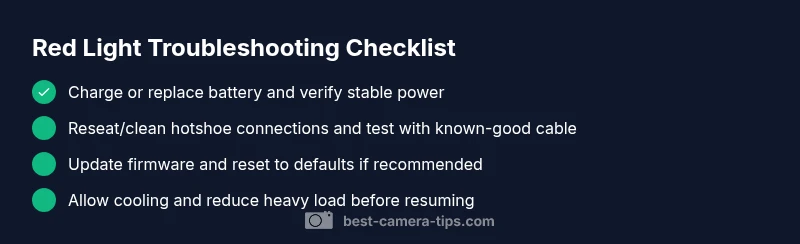
- easyCharge or replace the battery and verify the power supply is stable
- easyReseat the flash or hotshoe unit, clean contact pins, and test with a different cable or sync method
- easyUpdate camera firmware to the latest version and perform a factory reset if issues persist
- easyAllow the camera to cool and reduce continuous shooting; enable power-saving modes during shoots
Common Questions
Why is my camera flashing a red light after I press the shutter?
A red light usually signals a fault in power, flash trigger, or firmware. Start with battery checks and a flash connection, then update firmware and reset if needed. If it continues, services may be required.
A red light after pressing the shutter typically means a fault in power, trigger, or firmware. Begin with battery and connection checks, then try a firmware update and reset; if it still happens, consider professional service.
Is a red light on a camera dangerous or harmful to the sensor?
Red-light flashes are faults, not normal indicators. They don’t inherently damage the sensor if you stop shooting and follow safe troubleshooting steps, but continuing to shoot can exacerbate issues. Always diagnose before resuming heavy use.
Red light signals faults, not inherent danger to the sensor. Stop shooting and diagnose before continuing.
Can firmware updates fix red-light flash issues?
Firmware updates can resolve signaling glitches and compatibility issues that cause red-light flashes. Install the latest version from the manufacturer and perform a reset if the update recommends it.
Yes, firmware updates can fix signaling glitches that cause red-light flashes.
Should I replace the battery if the red light appears during a shoot?
Yes. A failing battery can cause voltage drops that trigger red lights. Replace with a fresh, compatible battery and test before resuming work.
If the red light appears, try a fresh battery and test again.
What if the red light flashes only in certain modes or lenses?
This often points to a bad connection in specific modes or with certain lenses. Check compatibility, clean contacts, and test across modes to isolate the issue.
If it only happens in certain modes or with a specific lens, check the lens connection and mode compatibility.
When should I seek professional service for a red-light issue?
If you’ve exhausted power, connection, and firmware fixes and the red light persists, professional diagnostics are recommended to prevent further damage and confirm whether a component replacement is needed.
If it keeps flashing red after trying fixes, seek professional service.
Watch Video
The Essentials
- Power checks first to rule out voltage issues
- Clean and reseat flash connections to restore proper signaling
- Update firmware and perform reset if needed
- Avoid continuous heavy loads that heat the camera
- Seek professional service if the red light persists after DIY steps