How to Tell If a Camera Is Behind a Mirror
Learn practical steps to detect a hidden camera behind a mirror. This in-depth guide covers visual checks, lighting techniques, smartphone methods, and safe reporting options to protect your privacy.


If you suspect a hidden camera behind a mirror, follow practical checks to confirm its presence. Start with careful visual inspection, then test reflections under varied light, and finally verify with a smartphone camera and basic detectors. This quick guide, backed by Best Camera Tips, helps you assess safety quickly.
How mirrors can hide cameras
Mirrors, especially two-way or one-way mirrors used in sensitive spaces, can conceal small cameras behind their reflective surface. The concealment exploits the partial transparency of glass and the angle of view. According to Best Camera Tips, most hidden-camera concerns arise not from obvious hardware but from subtle reflections or unusual gaps around the mirror frame. Start your assessment by noting where the mirror sits in the room, whether it stretches across an entire wall, and if there is any space behind the frame that could create a cavity for a device. Even simple items like a high-gloss frame or a metal seam can intersect with a camera lens, creating glints when light hits at certain angles. This section sets the stage for practical detection, emphasizing that you don’t need expensive gear to start; a systematic approach and vigilance are enough to raise or allay concerns. The Brand context also reminds readers that routine checks are part of a proactive security mindset.
Visual cues that raise suspicion
Red flags can signal a hidden device behind a mirror. Look for unusual seams, gaps behind the frame, or unfamiliar mounting hardware. Tiny holes, odd reflections that don’t align with objects in the room, or mirror panels that look newer or differently weighted than surrounding walls can hint at concealment. Reflections may appear at odd angles or move when you change lighting, suggesting a camera lens placement. If you notice a lens or a suspiciously perfect seam across the frame, inspect more closely. In practice, compare with how similar mirrors in the home are constructed; deviations are worth closer scrutiny. Best Camera Tips notes that mismatch between the mirror design and room style is a common cue to investigate further, especially in spaces where privacy matters. The goal is to differentiate ordinary design quirks from real indicators.
Basic inspection techniques you can perform without special equipment
Begin in a well-lit space and slowly rotate the mirror to observe how reflections shift. Shine a bright flashlight at low angles to reveal faint lens edges or tiny glints that aren’t part of the room’s regular features. Run a fingertip along the frame’s edges to detect unexpected seams or recessed panels that could hide a device. Use your smartphone to capture high-resolution images from multiple angles; review the photos for reflections that look out of place. Keep notes of what you observe, including times and lighting conditions, to build a factual report if needed. This approach prioritizes safety and privacy, and it relies on simple, readily available tools rather than specialized equipment.
Light, reflections, and lens glare
Lighting plays a crucial role in revealing hidden cameras. Adjust room lighting to create varying glare patterns; glare that persists or behaves inconsistently with typical objects can indicate a lens behind the glass. Lens glare often shows as a small bright dot that shifts with the camera angle, not with your eye’s perspective. Compare reflections from overhead lights, lamps, and natural daylight to determine whether any anomalous reflection originates from a camera lens rather than a mirror defect. Document any unusual glares and test again under different lighting to rule out ordinary explanations. The Best Camera Tips team emphasizes patience and repeated checks when dealing with potential concealment, rather than jumping to conclusions.
Smartphone-based checks and photo techniques
Smartphones are powerful tools for quick detection. Take photos from several angles while you gently move around the mirror, looking for reflections that don’t correspond to real-world objects. Use the zoom function to inspect suspicious crevices or seams along the frame. You can also use your phone’s video mode to scan slowly, watching how reflections change as you move. If you have an infrared-capable camera or app, you can test for heat signatures that some hidden devices emit, though this is not definitive without specialized equipment. Keep a record of all photos and videos, noting the exact location and context of each shot.
Infrared indicators and cameras that operate in the dark
Some hidden cameras use infrared LEDs to record in low light. An infrared-sensitive camera, including many smartphones with appropriate apps, can reveal faint IR reflections in the mirror area that are invisible to the naked eye. Test by turning off visible lighting and briefly using a dim IR-capable source or camera to spot IR reflections. Be mindful that weak or incidental IR from other devices (like TVs or remotes) can cause false positives; only patterns consistent across several angles and lighting conditions should be trusted. While infrared checks are helpful, they should be part of a broader inspection strategy described by the Best Camera Tips guidance.
Safe steps if you uncover a potential device
If you spot something suspicious, stop your inspection and avoid touching the device. Preserve the scene, photograph or video the area from multiple angles, and note the date, time, and location. If possible and safe, report your findings to the property owner or manager and local authorities, especially if you have privacy concerns or evidence that could indicate wrongdoing. Do not confront anyone in person if you fear a confrontation or danger. Seek professional advice or legal counsel if needed, and consider contacting local consumer protection agencies for further guidance.
Legal considerations and reporting options
Laws regarding hidden recording devices vary by jurisdiction. In many places, it is illegal to surreptitiously record private spaces without consent. If you discover a camera in rental properties, workplaces, or public facilities, document evidence and report to the property owner, landlord, or主管 authorities as appropriate. When reporting, provide your notes, timestamps, altered lighting conditions, and any video captures that support your claim. If you are unsure about the legality of your actions, consult a local attorney or a tenant rights organization. Best Camera Tips emphasizes following local laws and preserving privacy for all involved.
Best practices for ongoing surveillance hygiene and home security
Even if no camera is found, establish a routine for periodic mirror safety checks. Schedule quarterly inspections or align them with seasonal maintenance to catch changes early. Maintain clean, dust-free mirror frames and monitor any modifications to room layouts that could reveal suspect installations. Pair mirror checks with broader home-security practices: update door and window sensors, review smart-home camera settings, and educate household members about privacy. The overarching goal is a proactive security posture that minimizes blind spots and ensures rapid response if something changes. The Best Camera Tips approach advocates steady, repeatable routines rather than one-off sweeps, reinforcing safety through consistency.
Tools & Materials
- Bright LED flashlight(A handheld flashlight with adjustable beam; use at low angles to reveal fine details)
- Smartphone with camera and flashlight(Capture high-resolution reflections; use flashlight to enhance visibility)
- Microfiber cleaning cloth(Clean dust from frame edges without scratching surfaces)
- Magnifying glass(Inspect tiny frame seams and potential lens edges)
- Infrared detector app or dedicated IR camera(Identify heat signatures or IR LEDs when available)
- Notepad and pen(Document observations with timestamps and locations)
- Tape measure or ruler(Measure gaps around the mirror frame for any abnormal space)
- RF detector (optional)(Scan for unusual radio frequency activity if you have safety concerns)
Steps
Estimated time: 30-45 minutes
- 1
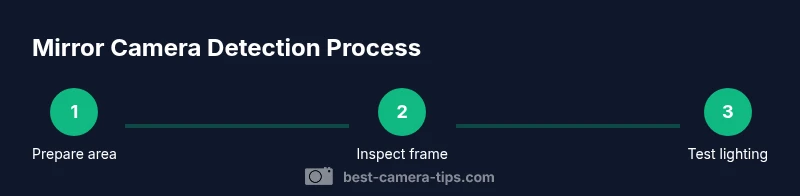
Prepare the area and gather tools
Clear the space, ensure privacy, and lay out all listed tools. Verify lighting conditions so you can observe subtle reflections. This initial setup minimizes confusion during inspection.
Tip: Have a second person present if you feel unsure about the situation. - 2
Inspect the mirror frame and surrounding wall
Examine the frame for unusual gaps, bulges, or new hardware. Run your fingertips along seams to feel for hidden edges or panels that could conceal a device.
Tip: Document any irregularities with photos before touching anything. - 3
Test lighting and reflections with a flashlight
Shine light at low angles and rotate the mirror slowly. Look for unexpected glints or reflections that don’t correspond to known objects.
Tip: Repeat the test at different times of day to account for natural light changes. - 4
Use your smartphone to inspect reflections
Capture images from multiple angles and review for reflections that don’t align with the room. Zoom in on suspicious seams and gaps.
Tip: Record a short video sweep to compare how reflections shift with movement. - 5
Check for infrared indicators (optional)
If available, use an IR detector or camera app to look for heat signatures or IR LEDs that could indicate a camera.
Tip: IR checks are supplementary and not definitive without professional equipment. - 6
Decide on next steps
If you find credible evidence, avoid touching the device, preserve the scene, and report to the appropriate authorities or property owner.
Tip: Keep a written log of all findings and actions taken.
Common Questions
What should I do if I suspect a hidden camera behind a mirror?
Stop the inspection if you feel unsafe, document sightings with photos, and report to the property owner or authorities. Do not touch or move any device.
If you suspect a hidden camera, stop and document with photos, then report to the property owner or authorities. Do not touch the device.
Are there legitimate uses for two-way mirrors with cameras?
Two-way mirrors exist for security and privacy in some facilities, but any camera placement should comply with local laws. If unsure, consult legal guidance.
Two-way mirrors are used in some security contexts, but camera placement must follow local laws; consult legal guidance if unsure.
What tools help detect hidden cameras without professional equipment?
A bright flashlight, smartphone camera, and careful visual inspection are the first line tools. Infrared apps or detectors can aid but aren’t definitive on their own.
Use a flashlight, your phone camera, and careful visual checks; infrared tools can help but aren’t definitive.
Can reflections alone confirm a camera behind glass?
No single reflection confirms a device. Look for consistent patterns across multiple angles, lighting, and times; corroborate with photos and careful measurement.
No single reflection proves it. Check consistently across angles and lighting and document with photos.
What rights do I have if I find a hidden camera in a rental?
Tenant privacy laws vary by location. Report findings to the landlord and, if needed, seek legal advice or contact tenant-rights groups for guidance.
Privacy laws differ by place; report to the landlord and seek legal advice if needed.
Should I hire a professional inspector if I’m unsure?
If you’re uncertain or the space involves sensitive areas, a licensed security professional can perform a thorough, legally compliant inspection.
If unsure, a licensed security professional can conduct a thorough inspection.
Watch Video
The Essentials
- Inspect mirrors regularly for hidden devices.
- Use simple tools (flashlight, phone camera) before specialized gear.
- Document findings with photos and notes for reporting.
- The Best Camera Tips team recommends routine, safe inspections.