Focus Camera: Mastering Sharpness with Practical Techniques
Learn precise focusing techniques for any lens and scene. This Best Camera Tips guide covers autofocus vs manual focus, focus modes, troubleshooting, and pro tips to keep your shots sharp across situations.


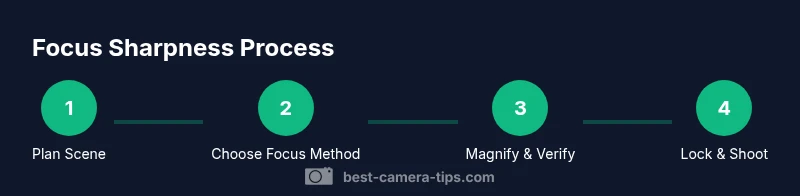
By the end of this guide you will be able to focus your camera with confidence across lenses and scenes. You’ll diagnose common autofocus vs manual focus issues, choose appropriate focus modes, and apply step-by-step techniques to lock sharp details in bright or dim light. Essentials include a steady setup and a clear test subject.
Understanding Focus Basics
In photography, "focus" refers to the plane where light rays converge to form a sharp image. This sharpness is influenced by depth of field, aperture, subject distance, and lens quality. According to Best Camera Tips, focusing accuracy begins with understanding your camera's focus system and the role of the focusing plane. Different cameras offer various autofocus mechanisms such as phase-detection and contrast-detection. Grasping these basics helps you troubleshoot why your images aren't sharp and sets the foundation for consistent results. Beyond theory, practical focus is about aligning your subject with the camera's chosen plane and confirming that your lens renders fine detail at the intended distance. This section lays the groundwork for selecting AF modes, manual focus strategies, and how to verify focus in different shooting contexts.
- Key terms to know: autofocus (AF), manual focus (MF), depth of field (DOF), focus plane, magnification.
- Quick diagnostic: if you zoom to 100% in live view and the subject remains soft, you may need to adjust focus method or distance.
Autofocus vs Manual Focus: When to Use Each
Autofocus is fast and convenient, but it isn’t flawless in every situation. Phase-detection AF excels in bright light and moving subjects, while contrast-detection AF can be more accurate on static scenes in live view. Manual focus shines when you have shallow depth of field, a difficult contrast scene, or macro work where the camera’s AF hunts. The right choice depends on your lens, camera body, and shooting conditions. For beginners, start with AF-S (single-shot AF) for still subjects and switch to AF-C (continuous AF) for moving targets. In low light or low-contrast scenes, MF with magnified live view provides the most precise results. Practically, blend tools: use AF to frame quickly, then MF to nail the final focus.
Choosing Focus Modes for Different Scenarios
Different scenarios demand different focus controls. For moving subjects (sports, wildlife), use continuous AF with Subject Tracking if available and select a dynamic focus area that follows the subject. For portraits, place a small focus area on the eyes or the nearest important feature and consider locking focus with back-button focus to separate focus from shutter release. For landscapes, hyperfocal distance estimation helps keep foreground and background sharp. In dim light, enable focus-peaking if your camera supports it and magnify the scene to confirm sharp edges. Use live view magnification to evaluate critical planes—this is especially useful with prime lenses or macro work where precise timing matters.
Techniques for Precise Focusing
To achieve precise focus, adopt a structured approach. Start with a single-point AF to control the focus plane, then switch to back-button focus to decouple focusing from shutter release. In MF situations, enable focus peaking or magnification to confirm sharpness on selected features like eyes or edges. When using macro or telephoto lenses, note the focusing throw—longer throws mean slower, more careful adjustments. Always shoot a test frame and zoom to 100% in LCD or EVF to verify. If needed, recalibrate distance by slightly adjusting your position rather than forcing the camera to hunt.
Focus in Challenging Conditions
Low light, backlit scenes, and moving subjects complicate focusing. In low light, increase ambient light with a reflector or lamp, switch to a faster aperture to boost light gathering, and rely on live view magnification to verify focus. For moving subjects, pre-focus on a spot you anticipate they will pass through and track them with a reliable AF system, keeping a comfortable distance to avoid focus hunting. Backlit scenes favor focusing on the subject against a brighter background by meter of exposure and set exposure compensation to prevent silhouette-focused mistakes. If your lens exhibits focus breathing or focus shift when stopping down, consider using focus peaking and recheck sharpness after exposure adjustment.
Common Focusing Problems and Fixes
Front/back focusing is the most common complaint. If your images consistently miss the intended plane, test with a ruler and calibration targets to quantify the discrepancy. Lens quality and misalignment between camera body and lens can cause focus drift; service or calibrate if needed. Hunting — the camera repeatedly searches for focus — often occurs in low contrast scenes or with older lenses. Try switching to a different AF area, enable live view magnification, and ensure your firmware is up-to-date. Lens, sensor, and micro-adjustment settings can all affect accuracy, so approach fixes methodically.
Tools and Practices to Verify Focus Sharpness
Sharpness verification benefits from a structured workflow. Create a small focus chart or use a simple object with high-contrast edges at several distances. Take test shots at each distance, then zoom to 100% to assess edge sharpness. Use a consistent lighting setup to minimize shadows that fool your perception of focus. Keep a notebook with lens, distance, AF mode, and focus point settings for later comparison. Recording such data helps you spot patterns and refine your routine. Regular practice with controlled subjects builds muscle memory and reduces on-site guesswork.
Lenses, Focus Throws, and How They Affect Accuracy
Lenses with short focusing throws are typically faster to acquire focus, while longer throws provide more precise control but demand steadier technique. Wide-angle lenses generally have more depth of field for forgiving focusing, whereas telephotos have shallower DOF, making precise focus more critical. Modern lenses offer focus motors that are quiet and fast, with micro-adjustment ranges to compensate for body-lens variations. If your camera supports AF microadjustment, calibrate per lens for best results. When focusing at night or in low-contrast mid-range, rely on magnification and peaking to lock onto small features or edges.
Accessories that Help Focusing
Helpful accessories include a reliable magnification loupe or live view magnifier, a sturdy tripod, and a remote shutter release to minimize camera shake. Focus aids such as focus peaking, zoomed-in LCD, and calibrated focus charts can dramatically improve accuracy. A good optical viewfinder with parallax-free framing helps pre-visualize focus in action, especially with non-zoom lenses. Consider a tilt-shift lens for critical perspective and plane alignment in architectural work where precise focus matters across depth. Utilizing these tools consistently builds confidence and reduces wasted shoots.
Practical Practice Routine to Improve Focusing
Make focusing a daily habit with a structured routine. Spend 15 minutes daily on a focus drill: choose a static subject at various distances, switch between AF and MF, and record results. Each week, introduce a new variable: lighting, subject movement, or different focal lengths. End each session with a 5-shot test set at 1:1 magnification to verify consistency. Track progress in a notebook or app and reflect on what settings produced the sharpest results. A disciplined practice routine improves your instincts and reduces dependence on auto settings in real-world scenes.
Tools & Materials
- Camera body with reliable focus controls(Ensure live view and focus peaking (if available))
- Interchangeable lens (vary focal length)(Choose focal lengths based on your typical subjects)
- Tripod(A sturdy base to minimize motion blur)
- Live View magnifier / focus magnifier(For precise MF and verification)
- Remote shutter release / timer(To reduce shake when manual focusing)
- Lighting (lamp, reflector)(Improves contrast for focusing in dim conditions)
- Lens cleaning kit(Keep front/back elements clean for accurate sampling)
- Focus chart or test subject(Useful for calibration and documentation)
Steps
Estimated time: 45-60 minutes
- 1
Set up a stable test scene
Place a static subject at a known distance and frame it with your preferred focal length. Use a tripod if possible to minimize camera movement. This initial setup creates a reliable baseline for focus testing.
Tip: Stabilize the camera first, then adjust distance to avoid accidental movement. - 2
Choose your initial focus mode
Pick AF-S/Single for still subjects or AF-C/Continuous for moving targets. If the lighting is challenging, consider MF with magnification to verify focus before shooting.
Tip: In dim light, AF can hunt—switch to MF to lock focus precisely. - 3
Select and center a focus point
Use a single-point focus or the closest important feature (eyes in portraits, edges in landscapes). Lock the point once set to prevent accidental shift during repositioning.
Tip: Center or align with the most crucial detail to anchor sharpness. - 4
Fine-tune with magnification
Engage live view magnification or focus peaking to confirm the critical plane is sharp. Make micro-adjustments until edges appear crisp.
Tip: Don’t rely on the LCD at normal magnification—mag down for critical checks. - 5
Recompose after focusing
If you must reframe, ensure the focus point remains in the area of interest or re-focus after recomposing—recheck sharpness.
Tip: Recheck or re-shot to avoid back/front focus drift. - 6
Capture a test frame and inspect
Take a test shot at the final settings and zoom to 100% in playback. Evaluate edge sharpness and consistency across the frame.
Tip: If softness appears, adjust distance or focus method and retake. - 7
Review, adjust, and repeat
Assess results under varying conditions and add iterations to your routine. This habit builds confidence and reduces reliance on auto settings.
Tip: Document which settings produced the best results for future sessions.
Common Questions
What is the difference between autofocus and manual focus?
Autofocus uses the camera’s sensors to find sharp focus automatically. Manual focus involves turning the lens to achieve sharpness by sight, which is useful in low contrast or macro work. Pairing AF for framing with MF for final micro-adjustment yields the best results.
Autofocus is automatic, but for critical detail, switch to manual focus and confirm with magnification.
How can I fix front- or back-focused photos?
Front- or back-focused images occur when the focus plane is misaligned. Use a calibration test with a ruler or target, adjust the lens-camera micro-adjustment if supported, and retest at multiple distances. If issues persist, service the lens or camera for alignment.
If your photos consistently miss the plane, test with a focus chart and consider professional calibration.
Which focus mode is best for moving subjects?
For moving subjects, use AF-C (continuous AF) or AI Servo, with a dynamic or large focus area. Enable Subject Tracking if available and practice panning to retain sharpness while following the subject.
Use continuous autofocus and tracking for moving subjects, then verify sharpness frame by frame.
Should I use live view for focusing on all lenses?
Live view magnification is highly effective for precise focusing, especially with macro or telephoto work. It may be slower for action, but yields accurate plane alignment in complex scenes.
Live view magnification can make precise focus easier, especially in macro work.
Can focus be improved with post-processing?
Post-processing cannot recover true out-of-focus details. You can improve perceived sharpness through sharpening and noise reduction, but it won’t restore misfocused data. Focus accuracy before shooting is essential.
Post-processing can enhance sharpness, but it can’t fix a poorly focused shot.
What role does depth of field play in focus accuracy?
Depth of field determines how much of the scene is acceptably sharp. A wider DOF (smaller aperture) makes focus less critical across the frame, while a shallow DOF requires precise focus on the intended plane.
More DOF is forgiving; less DOF needs exact focus on the right plane.
Watch Video
The Essentials
- Develop a solid focus baseline with a controlled test scene.
- Choose AF or MF based on subject motion and contrast.
- Verify focus with magnification and 100% view before shooting.
- Use back-button focus to gain consistent control over sharpness.
- Regular practice leads to repeatable, reliable focus in real-world conditions.