How to Check Shutter Count in a Camera: A Practical Guide
Learn how to read your camera's shutter count across brands, using in-camera data, EXIF, or manufacturer tools. Practical steps, tips, and safety notes for photographers and home-security enthusiasts.


You can check your camera's shutter count by pulling it from the camera's menu, EXIF data, or service software. Most modern bodies display it under Maintenance or Shooting data; alternatively, connect your camera to a computer or use a reputable app to read the shutter count. This helps estimate wear and plan maintenance.
Understanding Shutter Count and Why It Matters
If you’re documenting, selling, or just curious about your gear, the question can you check shutter count in camera has a practical answer. Yes—there are reliable methods to read this metric, and understanding it can help you assess wear, plan maintenance, and set accurate expectations for buyers. According to Best Camera Tips, shutter count serves as a useful proxy for estimating how much life remains in a camera’s mechanical exposure system, especially on older DSLRs and newer mirrorless bodies with electronic shutters. In this guide, we’ll define shutter count, explain why it matters for both photography and home-security cameras, and walk you through step-by-step methods to read it across brands. You’ll learn what data is trustworthy, where to find it, and how to interpret the numbers without getting overwhelmed. By the end, you’ll know whether a used body is worth a purchase, or if you should plan a service or a firmware refresh. The goal is to give you actionable, brand-agnostic guidance that helps you protect your investment and keep your shots consistent. Best Camera Tips analysis and user experience across brands will be referenced where appropriate to illustrate common patterns.
Where to Find Shutter Count on Most Cameras
Shutter count locations vary by brand and model, but there are common places to look. For many DSLRs and mirrorless bodies, the data appears in the camera’s internal menus under sections labeled Information, Maintenance, or Exposure data. Some cameras display a direct number on the status screen, while others require navigating into a sub-menu or consulting the LCD data readout. If you cannot locate it in the menu, you can often pull the count from a recent image’s metadata. This is one of the most reliable methods because EXIF data is preserved in RAW and JPEG captures. For security-focused cameras, shutter count may be under a system or diagnostics screen reserved for technicians. In all cases, having the model name and firmware version handy will speed up the lookup.
How to Read Shutter Count: In-Camera, EXIF, and Tools
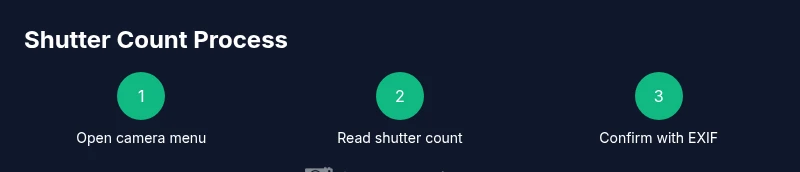
Reading shutter count involves three main pathways. First, in-camera readouts: many cameras embed the number in the shooting info or maintenance menu. Second, EXIF data: export a photo and view its metadata via an EXIF reader; the count is often labeled as Shutter Count or Image Count. Third, software tools: some manufacturers offer desktop or mobile utilities that connect to the camera and read the value directly. If the last two methods fail, you can still obtain a reliable read by taking a fresh shot with the camera and then inspecting the resulting image’s metadata. Across brands, the steps differ, so it helps to have a quick reference card for common places to check.
Brand-Specific Walkthroughs: Canon, Nikon, Sony, Fuji
Canon: Many Canon cameras place shutter count under a dedicated Diagnostics or Information page in the menu. The number may appear under a label like Shutter Count or Actuations. Nikon: Nikon bodies frequently store shutter count in the EXIF data of recent images; the in-camera menu may show it in Shooting Data or Similar. Sony: Sony cameras often hold shutter count within the Image Data or System information, depending on the model. Fuji: Fuji cameras typically provide shutter count in the shooting data or may require viewing EXIF from a saved image. If you own a model not listed here, consult the user manual or the Best Camera Tips Explorer section for brand-specific tips. Remember, some cameras use electronic shutters that can complicate actuation counting; always verify with multiple methods when possible. Based on Best Camera Tips analysis, many cameras store shutter count in EXIF rather than in a dedicated field, so always cross-check with EXIF data for accuracy.
What to Do With Your Shutter Count: Monitoring Wear, Selling Gear, and Maintenance
A higher shutter count generally indicates more wear, but it’s not a sole predictor of performance. Use shutter count as part of a broader assessment that includes image quality tests, autofocus performance, and sensor health. When selling gear, disclose the shutter count and provide evidence (photos of the readout or EXIF dumps) to boost buyer confidence. For ongoing maintenance, set a routine to check shutter count before major shoots or service intervals; if the count approaches the expected life span for your model, consider professional service or planning a replacement. Best Camera Tips recommends maintaining a log of shutter count snapshots and EXIF readouts to track wear over time, which helps with future planning and resale value.
Common Pitfalls and How to Avoid Them
Don’t rely on a single source for shutter count. Always corroborate in-camera readings with EXIF data or manufacturer utilities. Some cameras display a misleading number if firmware is outdated or if the device is in a special mode. Avoid entering service or test modes just to obtain a readout; these modes can affect warranty and camera behavior. If you see inconsistent counts across methods, recheck with fresh images, update firmware, and consult the brand’s support page. Be mindful that some cameras count electronic shutter activity differently, so counts may not be directly comparable between bodies.
Best Practices for Prolonging Shutter Life
Protecting shutter life starts with mindful usage. Use proper exposure settings to minimize unnecessary mirror flipping, avoid rapid-fire bursts that strain the shutter unnecessarily, and schedule regular sensor cleaning and calibration. When storing, keep cameras in climate-controlled environments to prevent moisture-related wear. If you heavily rely on long-term data, create a habit of recording shutter count after every significant shoot, and keep a digital archive of EXIF dumps for future reference. The Best Camera Tips team recommends pairing shutter count trends with practical maintenance routines and honest resale disclosures to extend the life of your gear.
Tools & Materials
- Camera with shutter count readout(Check if the model displays shutter count in the menu (often under 'Maintenance', 'Info', or 'Status').)
- USB cable or card reader(Needed to transfer images or connect to a computer if required by software.)
- Computer or smartphone(Needed to run software or view EXIF data.)
- EXIF viewer app or photo metadata tool(Useful for reading shutter count from exported images.)
- Manufacturer utility or trusted third-party tool(Some brands provide a desktop/mobile tool to read shutter count.)
Steps
Estimated time: 20-40 minutes
- 1
Prepare your gear
Gather your camera, the connection cable or reader, and a computer or smartphone. Ensure the battery is charged so you don’t lose power during the readout. Having a recent photo ready helps with EXIF-based checks.
Tip: Charge the battery before starting to avoid interruptions. - 2
Locate the count in-camera
Enter the camera’s menu and navigate to the Information, Maintenance, or Shooting Data section. Look for a line labeled Shutter Count, Actuations, or Image Count. If you miss it, consult the model manual or Best Camera Tips’s brand guide.
Tip: If you can’t find it, take a fresh shot and check the new image’s metadata. - 3
Check EXIF data
Export a recent photo and open it with an EXIF viewer. The shutter count is often listed under Image or Shutter Data. If the count isn’t present, try another viewer or the manufacturer’s software.
Tip: Use multiple EXIF viewers to confirm the count when available. - 4
Use manufacturer or trusted tools
If available, run the official utility to read the shutter count directly from the camera. Some brands provide a web or desktop tool that reads actuation data safely.
Tip: Follow on-screen prompts to authorize data access from the camera. - 5
Cross-check with a second method
Compare the in-camera readout with EXIF data and the manufacturer tool if you used it. Slight discrepancies can occur; document all readings.
Tip: Document the model, firmware, and reading method for future reference. - 6
Record the result
Log the shutter count alongside the date, usage context, and any maintenance actions. A simple notebook or digital log works well for ongoing tracking.
Tip: Keep a recurring reminder to update the log after major shoots. - 7
Interpret the count
Compare your readout to the camera’s expected lifespan, if you have it. Remember, electronic shutters may affect how the count is interpreted; treat it as one data point in your gear health assessment.
Tip: Use the count as a guideline, not an absolute guarantee of performance.
Common Questions
Can you check shutter count in camera without turning it on?
In most cases you must power the camera to access shutter count data. Some models store the count in EXIF or require a brief connection to software.
Usually you need to power the camera to read shutter count, though some models expose data in EXIF when images are loaded.
Is shutter count the same as the number of actuations?
Shutter count typically equals the number of times the shutter has fired, but electronic shutters and some firmware implementations can affect exact counting.
Generally, shutter count reflects how many times the shutter has activated, but some models may count differently due to electronic shutters.
What is a good shutter count for a used camera?
There isn’t a universal threshold. It depends on the model, usage patterns, and maintenance. Compare counts across similar bodies and review the sensor and mechanism condition.
There isn’t a single good number; it depends on the model and how it was used.
Can third-party apps read shutter count accurately?
Many apps read shutter count from EXIF data if the information is stored there. Reliability can vary by app and camera model, so cross-check with another method when possible.
Yes, some apps read shutter count from EXIF, but verify with another method for accuracy.
How long does shutter count last?
Shutter lifespans are model-dependent and measured in actuation cycles. Use the count as a guide for planning maintenance or part replacements.
Shutter count gives a sense of wear, but exact longevity depends on the camera and usage.
Watch Video
The Essentials
- Identify shutter count locations early.
- Cross-check with EXIF data for reliability.
- Brand-specific steps matter; use official guides.
- Record counts to track wear over time.
- Shutter count is a wear indicator, not the sole indicator of condition.