Camera Won't Scan QR Codes: Quick Troubleshooting Guide
If your camera won't scan qr code, this step-by-step guide helps you diagnose lighting, lens cleanliness, codes, and permission issues to restore fast scanning on iOS and Android.


Most QR scan problems stem from simple, fixable causes: dim lighting, a dirty or smudged lens, or outdated app permissions. Start with a quick win: clean the lens with a microfiber cloth, ensure the scene is evenly lit, and verify the camera access is enabled in the app. If it still won’t scan, restart the app and try another QR code. If issues persist, update the app and device OS.
Why your camera won't scan qr code
If you’re reading this, you’ve likely encountered a frustrating moment where the camera won’t scan qr code. The problem is rarely about the QR itself; more often it’s about lighting, the camera lens, or how the scanning app is allowed to use the camera. In practice, most users can restore reliable scanning by addressing three basics: the lens condition, the lighting environment, and the app permissions. Throughout this guide we’ll use the exact phrase camera won't scan qr code to emphasize how common and solvable this issue is across devices and apps. By focusing on practical checks, you’ll usually eliminate the most common culprits within minutes.
This moment matters for photographers and home-security setups alike, because QR codes are often used for fast configuration, product authentication, or rapid pairing. A reliable QR scan saves time and reduces the risk of missing important setup steps. According to Best Camera Tips, most scanning issues originate from simple, addressable causes, not from your device’s hardware being broken.
Quick checks for immediate improvement
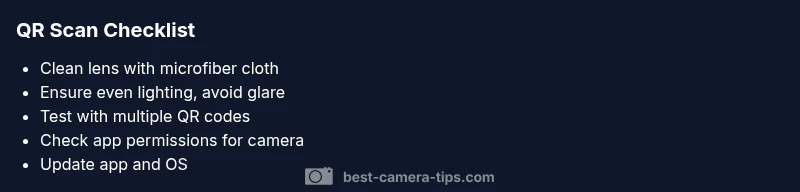
Before diving into diagnostics, perform these quick checks that directly address camera won’t scan qr code issues. They cover the most frequent scenarios and often fix camera scanning problems without tools. If the quick checks fail, proceed to the diagnostic flow below to identify less obvious causes. Regularly revisiting these steps keeps your scanning reliable during field work or at home.
- Ensure your hands are steady and the camera is not moving while focusing. Shaky hands can cause blurring that makes QR codes unreadable.
- Verify there is no glare on the QR code from overhead lights or screen reflections. High glare reduces contrast and can prevent recognition.
- Clean the camera lens with a microfiber cloth. Fingerprints, dust, or smudges reduce sharpness and worsen focus.
- Check that the QR code is in focus and at a reasonable distance. If you’re too close or too far, the code won’t be read. Adjust distance and use autofocus if available.
- Confirm the app has camera permissions enabled. Without access, the scanner can’t acquire frames for analysis. If permissions were ever revoked after an update, re-enable them.
- Update the scanning app and the device OS. Software updates often fix compatibility issues and improve recognition.
If you notice any of these patterns recur—low contrast, smudges, or permission prompts—treat them as your primary targets in the diagnostic flow.
Common causes in depth
Many issues that stop the camera from scanning qr code fall into a few broad categories. Understanding these causes helps you decide which fixes to try first. This section expands on the quick checks and adds nuance for unexpected scenarios like printing quality, color misreads, or non-standard QR code formats. If you’ve already addressed lighting and lens cleanliness but still struggle, it’s time to escalate to more formal diagnostics.
- Lighting and contrast problems: QR codes require clear contrast between the dark modules and light background. Dim rooms, backlighting, or colored reflections can obscure the pattern. In low-contrast codes, the camera may fail to segment the pattern.
- Lens and optical cleanliness: Smudges, fingerprints, or scratches degrade sharpness and can interfere with edge detection. Regular cleaning is essential for reliable scans, especially on phones that sit in pockets or purses.
- Code quality and size: Very small codes or damaged codes with missing modules are harder to read. Always test with a known-good sample or a fresh print.
- App permissions and camera settings: If an app doesn’t have camera access or has limited focus control, scans can fail even if the camera works. Some devices require additional permissions for use in the background or for specific camera modes.
- Hardware or sensor issues: Rarely, a degraded camera sensor or startup failure can prevent any scanning. If you’ve exhausted software fixes, consider professional evaluation.
Diagnostic flow primer: understand the symptoms and identify likely causes
This section provides a concise guide to using symptoms to drive the diagnosis. It helps you map what you’re seeing to a likely cause and then pick the most effective fixes. The flow assumes you’re troubleshooting with a standard QR code and a modern smartphone or camera app. Remember to document which steps you tried so you can repeat successful practices later.
- Symptom: camera won't scan qr code. Start with symptom checks: note lighting, glare, lens cleanliness, code quality, and permissions.
- Cause candidates: Poor lighting (high likelihood), dirty lens (high), code quality (medium), permissions (high), hardware idle states (low).
- Primary fixes: Clean lens, improve lighting, verify permissions, update software, and test with a different code.
Step-by-step overview to fix camera won't scan qr code
The following overview summarizes the exact fixes you’ll apply in the step-by-step section. It ensures you have a roadmap from simple to more involved actions. Each step builds on the previous one, reinforcing the error-proofing approach you need when a camera won’t scan qr code. If you’re ever unsure, proceed with caution and verify results after each action.
- Clean the lens and check for smudges.
- Improve lighting or reduce glare.
- Clean or test another QR code.
- Verify camera permissions and settings in the scanner app.
- Update app and device OS.
- If problems persist, contact support or hardware specialist.
Safety, best practices, and common mistakes
When you troubleshoot a camera won't scan qr code, safety and accuracy matter. Avoid applying liquids near the camera. Don’t force close folds or bend the lens assembly. Use a clean microfiber cloth and gentle pressure to avoid scratches. Common mistakes include testing codes that are too small, ignoring glare sources, and neglecting permission prompts. Following best practices helps you prevent similar issues in the future.
- Best practice: keep your lens clean and free of fingerprints.
- Best practice: test multiple codes from different sources to confirm issue consistency.
- Caution: avoid applying liquids near the camera lens or sensor.
Prevention: keep QR scanning reliable going forward
Proactive steps save you time in the long run. Establish a routine for checking lens cleanliness, lighting, and permissions after software updates. Maintain a few backup QR codes for testing purposes so you can quickly validate scanning accuracy. Finally, keep your device and scanner apps updated to minimize future disruptions.
Final checks before seeking help
If the camera still won’t scan qr code after completing the above steps, record your observations and test results. Note the device model, OS version, app version, lighting conditions, and the QR code’s characteristics. Share these details with customer support or a technician to speed up diagnostics. Often, the issue is resolved by the next software release or a simple hardware reset.
Steps
Estimated time: 30-45 minutes
- 1
Clean the lens
Power off the device if possible. Use a microfiber cloth to gently wipe the lens in a circular motion until no smudges remain. Avoid using harsh chemicals that could damage coatings. Reopen the camera app and retry scanning a QR code.
Tip: Carry a microfiber cloth in your camera bag for quick cleanups. - 2
Improve lighting
Move to a well-lit area or use a diffuse light source to minimize shadows and glare. Position the QR code so the light hits it evenly without hot spots. Try multiple angles to improve contrast.
Tip: Natural daylight often provides the best contrast for QR codes. - 3
Test with another QR code
Use a different QR code or a known-good sample to determine if the issue is with a single code or the scanner overall. If the new code scans, the original code may be damaged or too small.
Tip: Avoid ultra-dense codes; some printers or displays degrade readability. - 4
Check app permissions
Go to your device settings and confirm the scanner app has camera access. On Android, ensure it isn’t restricted by battery saver modes. On iOS, verify that the app has permission under Privacy > Camera.
Tip: If permissions were changed recently, re-authorize and re-launch the app. - 5
Update software
Update the scanner app to the latest version and check for an OS update. Software updates often fix bugs that affect QR recognition and camera integration.
Tip: Set apps to auto-update to avoid missing critical fixes. - 6
Restart and re-test
Close the scanner app completely, restart the device, and reopen the app. Test scanning again with multiple codes and distances.
Tip: A simple restart solves many transient recognition issues. - 7
Assess hardware as needed
If scans still fail across apps, consider hardware checks for the camera module. Internal dust, lens alignment, or sensor faults may require professional service.
Tip: Document model and symptom details when contacting support.
Diagnosis: Camera won't scan
Possible Causes
- highPoor lighting or glare
- highLens dirty or smudged
- mediumQR code damaged or low contrast
- highApp permissions or camera disabled
- lowCamera hardware issue
Fixes
- easyClean the lens with a microfiber cloth
- easyImprove lighting or remove glare from the scene
- easyTest with a different QR code or print quality
- easyRe-enable camera permissions in the scanner app and device settings
- easyUpdate the scanner app and device OS
- mediumIf hardware issues persist, consult support or a service technician
Common Questions
Why won't my camera scan qr code even when the code is fine?
Most often the problem lies in lighting, lens cleanliness, or app permissions rather than the code itself. Start by cleaning the lens and improving lighting, then check that the app has camera access and that both software layers are up to date.
Common QR scanning issues usually come from lighting, lens cleanliness, or permissions. Start with a clean lens and good lighting, then verify permissions and updates.
My QR code is damaged; will it still scan?
Damaged or poor-quality codes can fail to read. Try a different QR code or print a fresh version with higher contrast and larger size to test scanning reliability.
If the code is damaged, try another code or print a higher-contrast version to test scanning.
Do permissions affect QR scanning on Android and iOS?
Yes. If the scanner app doesn't have camera access, it cannot capture frames for decoding. Re-enable permissions in the device settings and retry.
Permissions matter; ensure camera access is granted to the scanner app and retry.
When should I seek professional hardware help?
If scans fail across multiple apps and codes despite software updates, there may be hardware issues with the camera sensor. Contact support or a technician for a diagnostic.
Consider professional help if multiple apps and codes fail despite updates.
Watch Video
The Essentials
- Clean the lens and improve lighting first.
- Verify app permissions and updates.
- Test with multiple codes to confirm the issue.
- If unresolved, seek professional help.