How Much Camera Lens Costs in 2026: A Practical Guide
This guide explains how much camera lens costs, from budget kits to professional primes, with realistic price ranges, buying tips, and value considerations for aspiring photographers.


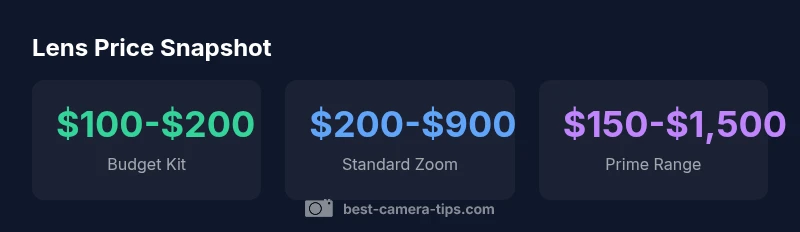
According to Best Camera Tips, lens prices show wide variation by type and features. Budget kit lenses typically start around $100–$200, standard zooms commonly run $200–$900, and primes span roughly $150–$1,500, with professional fast primes and specialty telephotos climbing higher into the several-thousand-dollar range. These ranges apply to new lenses; used gear can offer further savings.
How much camera lens costs vary
According to Best Camera Tips, pricing for lenses is not a single number but a ladder of options that scales with your needs. The core categories—budget kit lenses, standard zooms, primes, and specialty telephotos—all sit at different price points. Costs are influenced by optical design complexity, maximum aperture, coatings, and build quality. Brand premiums also play a role, particularly for mounts with broad system ecosystems (Canon, Nikon, Sony, etc.). For newcomers, it’s critical to balance your immediate capture capabilities with future growth potential. The goal is to maximize value, not simply chase the newest release. If you’re unsure where to start, map your most frequent subjects and shooting conditions, then pick a focal length or two that covers those scenarios well without duplicating coverage you already have in your kit. This approach helps you avoid overspending on lenses you’ll outgrow in a few months.
What drives lens prices
Lens pricing is driven by multiple intertwined factors. The number of optical elements and their precision determine manufacturing costs. A larger maximum aperture (lower f-number) typically requires more complex glass and coatings, pushing the price higher. Additional features—image stabilization, weather sealing, high-speed autofocus motors, and durable metal housings—also raise costs. Brand premiums add a layer of cost for popular ecosystems, while third-party makers often offer compelling value at lower price points without compromising essential quality. In practice, you’ll see a wide array of options: from inexpensive consumer-focused designs to fast, professional-grade glass. Market dynamics, such as production scale and currency shifts, can also shift sticker prices on new releases. Understanding these drivers helps you evaluate lenses by value, not just sticker price.
Price ranges by lens category
Budget and entry-level lenses
These are often bundled with camera bodies or sold at the lowest non-kit price points. They provide usable image quality and compact form factors, making them a solid starting point for beginners who want to learn fundamentals without a large upfront investment.
Standard zooms
Versatile and popular for general photography, these lenses cover common focal ranges and balance cost with flexibility. They’re ideal for learning composition, exposure, and autofocus behavior across a variety of scenes, from portraits to landscapes.
Primes (50mm, 35mm, 85mm, etc.)
Primes typically deliver sharper images and faster apertures than zooms, which is why many enthusiasts upgrade to one or two fast primes. Prices rise with speed (lower f-number) and optical quality. Budget primes around f/1.8–f/2.8 offer great value for low-light shooting, while premium primes with f/1.4 or faster can be substantially more expensive.
New vs used: value and risk
The used market can be a practical way to stretch a budget, but it carries risks. When evaluating a used lens, check for physical damage, coating wear, internal dust or haze, fungus, and mold—these issues can degrade image quality. Always test autofocus and stabilization if applicable, and inquire about past usage and service history. If buying from a reputable dealer, look for warranties or return windows. Compare prices against current new models to gauge savings; significant discounts on older generations may still offer excellent value if the optical performance remains competitive. For many photographers, a carefully chosen used lens can fill a gap between two major purchases and extend the life of your system.
Buying strategies to maximize value
A practical approach combines planning and staged upgrades. Start with a versatile zoom or a dependable prime and then expand with a second lens that fills your gaps. Use rental services to test lenses before buying. When you decide to buy, compare prices across retailers and consider reputable used marketplaces, bundle deals, and warranty extensions. Factor in image stabilization for outdoor work and weather sealing for challenging environments. Create a long-term gear plan: which focal lengths will you rely on most, what subjects do you shoot, and how might your kit evolve over 2–3 years. A thoughtful path reduces regret and builds a coherent system.
Case studies: typical beginner setups
Scenario A focuses on portraits and travel. A practical starting point is a kit lens plus a fast prime (for example, 50mm f/1.8 or 35mm f/1.8) to balance versatility with low-light performance. Scenario B targets wildlife on a budget: consider a mid-range telephoto zoom (like 70-300mm) or a used longer prime to extend reach without a steep price jump. In both scenarios, pair your lenses with a basic protective setup (filter, pouch) and a plan for future upgrades as your style becomes clearer.
Maintenance and resale value: protect your investment
Caring for your lenses helps maintain image quality and resale value. Clean the glass with proper wipes, store lenses in a dry place, and avoid rapid temperature changes. Use lens caps consistently, and keep the original packaging when possible. Stay current with firmware updates for compatible bodies and lenses. Documented maintenance and a clean condition report can improve resale value when you’re ready to upgrade. Proper storage and care also reduce repair costs and preserve optical performance for years.
Common lens price ranges (approx.)
| Lens Type | Typical Price Range | Notes |
|---|---|---|
| Kit lens (bundled with body) | $0-$200 | Often included; value varies by kit and brand |
| Standard zoom (e.g., 24-70mm) | $200-$900 | Versatile, common choice for many shooters |
| Prime lens (50mm, 85mm, etc.) | $150-$1,500 | Better sharpness and speed; depends on max aperture |
| Telephoto zoom / fast primes | $400-$4,000+ | For reach or ultra-low light; price scales with features |
Common Questions
How much should I spend on my first lens?
For a beginner, a versatile prime (like 50mm f/1.8) or a basic kit lens typically costs between $100 and $300 new. If you need more flexibility, plan for $200-$500 for a mid-range zoom. Buying used can save money but check condition and return options.
As a beginner, you can start with a basic kit or a 50mm prime for a few hundred dollars.
Are used lenses a good deal?
Used lenses can offer significant savings if purchased from reputable sellers with a return policy. Inspect optics for scratches, haze, fungus, and check that autofocus and stabilization work before committing.
Used lenses can be smart buys if you check condition and seller reliability.
Should I buy primes or zooms?
Primes generally deliver sharper images and faster apertures but require more moving to frame scenes. Zooms provide flexibility across focal lengths. A common approach is kit zoom plus one fast prime to cover base needs.
Primes give sharpness; zooms give flexibility, so a mix often works best.
Do I need a telephoto lens for wildlife?
A telephoto lens helps you reach distant subjects and compress perspective, which is valuable for wildlife and sports. Prices vary broadly; start with a mid-range telephoto if you’re new, or consider a used option to stretch budget.
Telephotos help with reach, especially for wildlife; budget accordingly.
How do I evaluate price vs performance?
Compare optical quality, autofocus speed, and weight against price. Rent or borrow to test before buying, and consider resale value. A simple rule: higher price should bring measurable gains in your shooting goals.
Test options if you can; balance cost with real-world gains.
“Lens pricing reflects optical complexity and build quality; invest in lenses that align with your shooting goals and future path. The returns come in better image quality and long-term reliability.”
The Essentials
- Define your shooting goals to choose the right lens.
- Budget kits start affordable; upgrades add value over time.
- Primes deliver sharpness; price scales with speed.
- Consider used lenses to stretch your budget safely.
- Rent before buying to test options and avoid buyer's remorse.