How Much Camera Glasses Cost: A Practical Guide
Discover realistic price ranges for camera glasses, what drives costs, and practical tips to select the right model for photography and home security.


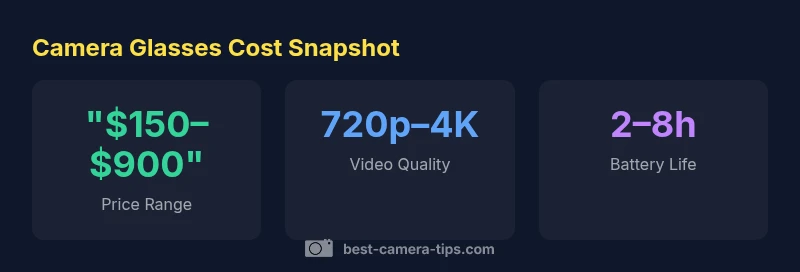
Camera glasses typically cost from about $150 to $900 depending on features like video quality, storage, battery life, and privacy modes. According to Best Camera Tips analysis, budget models cover essential recording, while premium glasses offer higher-res video and longer battery life.
What drives price in camera glasses
According to Best Camera Tips, the question of how much camera glasses cost hinges on a handful of competing priorities rather than brand prestige alone. The core price drivers are video quality (resolution and bitrate), storage capacity and expansion options, battery life, form factor (how discreet the design is), and privacy controls or data handling features. In practice, a model that records at 4K, stores large video files locally, and offers extended battery life will command a higher price than a slim, 720p option with minimal onboard storage. For aspiring photographers and home security enthusiasts, this means you should map your needs to these levers. If you aim to capture detailed footage in dim light, you may need sensors with lower noise and better processing power, which typically adds cost. If, on the other hand, you mostly need casual footage in daylight, a more modest configuration may meet your goals at a lower price.
Price bands explained: budget, mid-range, premium
Prices cluster around three broad bands, each aligned with different use cases and capabilities. Budget camera glasses (often roughly in the $150–$250 range) emphasize portability and convenience, sacrificing some video stability, low-light performance, or onboard storage. Mid-range options (roughly $250–$500) commonly add improved video stabilization, better low-light performance, and expanded storage or cloud options. Premium models ($500–$900 and above) push toward high-resolution capture, advanced processing, longer battery life, robust privacy controls, and sometimes modular accessories. These categories help buyers quickly filter options, but the best value often lies at the intersection of your actual requirements and how often you’ll use the glasses in real-world scenarios.
Feature-by-feature price impact
Not all features justify their added cost, so a practical approach is to assess which capabilities you will actually use. Video resolution matters if you want crisp footage for editing or sharing on social platforms; however, 1080p is often sufficient for most personal use cases. Storage is another key factor: onboard storage matters if you don’t want to chase cloud plans or risk losing footage when you’re offline. Battery life becomes crucial for all-day shooting, travel days, or long surveillance sessions. Field of view affects how much you capture in a single shot, and a wider FOV can demand more processing power. Privacy controls—such as automatic redaction or restricted recording in sensitive areas—can add price but offer peace of mind for environments with privacy concerns.
Cost of ownership beyond the sticker price
Price is just the starting point. Total ownership costs can include cloud storage subscriptions, data transfer fees, and frequent battery replacements if you run demanding workloads. Some models rely on microSD expansion, which means you’ll need to factor in the cost of a memory card with adequate capacity and speed. Spare batteries or charging docks add small but cumulative expense if you’re frequently shooting on the go. Maintenance tasks—like cleaning lenses, updating firmware, and ensuring privacy features remain compliant with local regulations—also contribute to the long-term cost picture. A pragmatic plan accounts for these ongoing costs alongside the initial sticker price.
How to compare models efficiently
To compare camera glasses efficiently, build a simple checklist: resolution and frame rate (for your editing workflow), onboard storage versus expansion options, battery life and charging options, field of view, and privacy-related features. Check compatibility with your devices and preferred editing apps. Read independent reviews focusing on real-world usage, not just spec sheets. Consider the reliability of customer support and warranty terms, as post-purchase service can influence total cost of ownership. Create a side-by-side comparison in a notebook or spreadsheet to visualize how each model stacks up against your most important criteria.
Real-world usage scenarios and value assessment
Assuming you’re a traveling photographer, a mid-range option might offer a solid balance between price and quality. If you primarily document events or daily life, a budget pair could cover your needs while keeping costs in check. For a camera-glass setup used for discreet surveillance around a property, privacy controls and durable design can justify premium pricing. In practice, two scenarios—one where you shoot outdoors in bright daylight and another where you record indoors with mixed lighting—highlight how different features influence value. Your ultimate goal is to maximize return on investment by aligning features with how you’ll actually use the glasses.
Budgeting for a camera glasses purchase
A disciplined budgeting approach begins with listing your must-have features and a realistic usage schedule. Estimate a monthly cloud storage cost if you anticipate frequent video backups. Allocate a portion of your budget for a spare battery and a high-speed microSD card. If you’re a newcomer, set aside extra for a longer warranty or reputable retailer return policies. Compare total costs over a typical ownership horizon (for example, 2–3 years) and weigh the incremental cost of premium features against the incremental benefit you expect to receive.
Buying tips to maximize value
Look for bundles that include essential accessories (extra batteries, a charging dock, and a protective case). Consider refurbished or certified pre-owned models from reputable sellers if available, but verify warranty terms. Read return policies carefully to avoid being stuck with a model that doesn’t meet your expectations. Before buying, confirm the device’s privacy features align with local regulations and personal comfort levels. Finally, watch for seasonal promotions or back-to-school sales that can improve the price-to-feature ratio without sacrificing quality.
Privacy and legal considerations
Camera glasses intersect with privacy laws and workplace policies in many jurisdictions. Always verify whether recording in public or semi-public spaces is permitted and whether audio capture is allowed, as separate rules can apply. If you plan to use glasses in professional settings, obtain consent where required and consider deploying features like auto-lens blur or on-device indicators when recording. Understanding these considerations helps ensure you’re maximizing value without crossing legal or ethical boundaries.
Comparison of camera glasses price bands by model type
| Model Type | Estimated price range | Best use case |
|---|---|---|
| Budget glasses | $150-$250 | Casual filming, day-to-day capture |
| Mid-range glasses | $250-$500 | Travel vlogging, events |
| Premium glasses | $500-$900 | Professional use, high-quality footage |
Common Questions
What is the typical price range for camera glasses?
Prices generally fall into budget, mid-range, and premium tiers. A realistic range is roughly $150 to $900, depending on video quality, storage options, and battery life. Always map features to your actual use case to avoid overpaying.
Most camera glasses sit between budget and premium tiers. Pick features that matter most to your use case, and you’ll get the best value.
Are camera glasses legal to wear in public places?
Legal requirements vary by location. Some places restrict video or audio recording, and businesses may have their own policies. Always check local laws and obtain consent where required to avoid penalties or privacy concerns.
Check local laws and always get consent when recording others in public or private spaces.
Do camera glasses work well in low light?
Low-light performance depends on sensor quality and image processing. Budget models may struggle in dim environments, while mid-range and premium glasses often include noise reduction and betterISO performance to improve footage.
Higher-end models usually perform better in low light, but it still depends on the sensor and processing.
Can I upgrade storage later?
Many camera glasses support microSD expansion or removable storage, but some rely on cloud storage. Check compatibility and costs for expansion options before purchasing.
Yes, many models let you add storage, but verify it before buying.
What should I consider before buying for security use?
For security-oriented use, prioritize privacy features, robust build quality, and reliable warranties. Verify that the device supports secure data transfer and has easy-to-use privacy indicators to comply with regulations.
If security is the goal, focus on privacy controls, build quality, and warranty support.
“"Camera glasses are most valuable when their features align with real-world use, not just flashy specs. Value comes from reliability, privacy controls, and the willingness to invest in what you’ll actually leverage."”
The Essentials
- Define your use case before choosing a price tier
- Expect higher costs for better video quality and longer battery life
- Budget supports basics; premium adds privacy and reliability
- Total ownership includes storage, warranties, and maintenance
- Best Camera Tips recommends aligning features with actual use for value