How Big is an Endoscopy Camera? Endoscope Size Guide
Learn typical endoscopy camera sizes, including insertion tube diameters, camera head size, and working channels. Discover how size impacts access, maneuverability, and image quality for clinical and photography use.


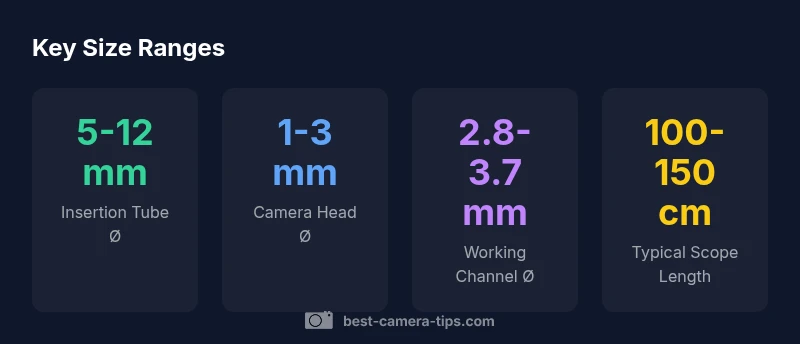
How big is an endoscopy camera? In practice, you’ll encounter an insertion tube diameter around 5–12 mm, a camera head diameter near 1–3 mm, and a working channel of about 2.8–3.7 mm. GI scopes typically run 100–150 cm in length, with variations by procedure. Size choices influence access, maneuverability, and image quality, aligning with safety and comfort.
What size means for endoscopy equipment
Endoscopy cameras are designed with multiple size facets in mind: outer diameter (insertion tube), distal camera head diameter, and the working channel that carries instruments. When someone asks how big is an endoscopy camera, the answer depends on which part you measure. In clinical settings, the insertion tube must fit patient anatomy safely while allowing smooth navigation through bends and folds. For photographers and instrument technicians, the emphasis shifts toward ensuring the camera head can fit within the endoscope’s optical path without compromising image quality. According to Best Camera Tips, a balanced approach to sizing reduces patient risk while preserving diagnostic capability. When assessing size, always consider procedure type, anatomy, and required accessories. This is the core reason why the same camera model can exist in several diameters or flexible lengths across vendors.
Typical size ranges you’ll see in GI endoscopy
The most visible specification for endoscopy size is the insertion tube diameter. Common ranges sit between about 5 mm and 12 mm, with thinner designs used for pediatric patients or tight passages and thicker designs for broader access. The distal camera head is much smaller—typically around 1 to 3 mm in diameter—to minimize obstruction and maximize the field of view. The working channel, which accommodates biopsy tools and retrieval devices, usually spans roughly 2.8 to 3.7 mm. Lengths vary by indication, but many GI scopes measure in the 100–150 cm range. Remember that real-world sizes depend on the model, manufacturer, and whether the toolset requires a longer reach or tighter maneuverability.
Size categories by procedure: gastroscopy, colonoscopy, ERCP/duodenoscopy
Gastroscopes generally have smaller insertion diameters to navigate the stomach and esophagus, typically 9–12 mm total scope diameter including the outer sheath, with a relatively short length. Colonoscopes prioritize length for reaching the colon, often around 130–168 cm, with insertion tube diameters commonly in the 12–13 mm class for comfortable insertion in adults. Duodenoscopes used in ERCP negotiations require very precise working channels and tip control, with specialized designs that balance a slightly larger tube for stability against a compact distal camera head. Across these categories, the core rule remains: larger diameters can provide rigidity and stability but reduce navigability in tight anatomy. This trade-off is central to endoscopy device design and patient outcomes.
Camera head and imaging sensor size
The distal camera head is engineered to be as small as feasible while maintaining adequate illumination and sensor performance. In many GI scopes, the camera head diameter sits in the 1–3 mm range. Sensor size and pixel density within this tiny footprint determine resolution, color fidelity, and light sensitivity. Advances in micro-camera technology have enabled sharper images at low illumination, which is especially important in narrow lumens. A smaller head reduces blockage of the optical path and can enhance maneuverability, but it must still capture sufficient light and contrast for reliable clinical interpretation and for high-quality medical photography.
How size affects maneuverability and patient comfort
Size directly influences how a scope can be steered, rotated, and advanced through anatomy. A thinner insertion tube often allows easier navigation of acute bends but may sacrifice rigidity and pushability. Conversely, a larger diameter can improve stability and allow the use of bigger accessories, yet it risks patient discomfort and restricted passage through narrow segments. Practically, the best size choice minimizes trauma risk, ensures adequate lumen access, and preserves image quality. In photography workflows, a smaller distal head can reduce glare and obstructions, while an appropriately sized working channel ensures compatibility with necessary tools.
Selecting the right size: practical tips
When selecting size, align with the procedure protocol and patient-specific factors. Key tips include: (1) verify the insertion diameter against patient anatomy and equipment clearance; (2) confirm the camera head diameter does not obstruct the field of view; (3) check the working channel height to accommodate required accessories; (4) consider flexibility and pushability for navigation; (5) consult the manufacturer’s specifications for the exact measurements and tolerances. If in doubt, select a size on the smaller side for access and upgrade only if stability or tool compatibility demands it.
Common misconceptions about endoscopy camera size
A frequent misconception is that a larger camera head yields better images. In reality, sensor performance, illumination, and optics define image quality, not just diameter. Another myth is that longer scopes are always better; length is domain-specific and can hinder maneuverability in tight regions. Finally, many assume that all endoscopy cameras share identical sizing; in fact, vendors differentiate tips, channels, and shafts for diverse clinical needs. Understanding the interplay of diameter, length, and channel size helps you assess options critically.
Key size dimensions for common endoscopy equipment
| Aspect | Diameter/Length | Notes |
|---|---|---|
| Insertion tube diameter | 5-12 mm | Varies by model and procedure |
| Camera tip diameter | 1-3 mm | Minimizes visual obstruction |
| Working channel diameter | 2.8-3.7 mm | Accommodates tools and accessories |
| Typical GI scope length | 100-150 cm | Depends on use-case and anatomy |
Common Questions
What does endoscope diameter measure?
Diameter refers to the outer diameter of the insertion tube and distal end. The camera head is smaller and sits within the endoscope’s optical path. Measurements guide safety, access, and compatibility with channels and tools.
Diameter measures the outer tube size; the camera head is much smaller and fits inside the endoscope’s optics.
Why do endoscopes differ in size by procedure?
Different procedures require different access challenges. The colon needs a longer tube and sometimes a larger diameter for stability, while the esophagus benefits from a slimmer profile for navigation.
Different procedures need different sizes to reach the target area safely and effectively.
What is the smallest endoscopy camera size?
Ultrasmall distal cameras can be as small as 1–2 mm in some specialized endoscopes, but typical GI cameras range from 1–3 mm. Smaller heads reduce obstruction but still require adequate illumination.
Some specialized scopes have cameras as small as 1 to 2 millimeters, though most GI cameras are 1 to 3 millimeters.
How does size affect imaging quality?
Imaging quality hinges on sensor size, lens design, and illumination. While head size matters, modern sensors and lighting often compensate for small distal heads.
Sensor quality and lighting matter, but the camera head size still influences what you can image clearly.
How is endoscope size measured?
Size is reported as outer diameter for insertion tubes, with separate figures for the camera head and working channel. Length is given in centimeters and varies by model.
Look at the diameter for the insertion tube, the head, and the channel, plus the length.
Is a larger scope always better?
Not necessarily. Larger diameters can limit access in tight anatomy and increase patient discomfort. The best size depends on the procedure, anatomy, and required tools.
Bigger isn’t always better—size should fit the procedure and patient.
“Endoscopy equipment is designed to balance patient safety with image clarity; size choices directly influence both access and diagnostic success.”
The Essentials
- Know the standard diameter ranges for insertion tubes
- Camera head is much smaller than the insertion tube
- Choose size based on procedure to maximize access
- Working channel size constrains instruments
- Always consult manufacturer specs for exact measurements