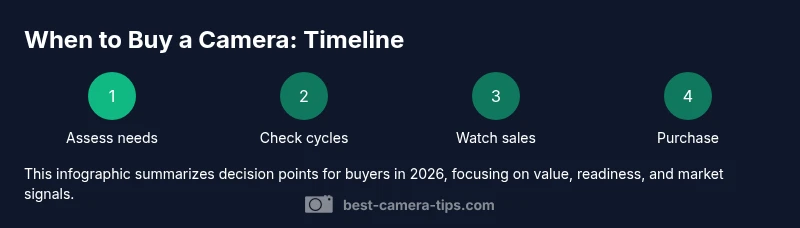
When to Buy Camera in 2026: A Practical Guide
Learn the best times to buy a camera in 2026, balancing model cycles, seasonal sales, and your needs. Practical guidance for beginners and enthusiasts to time purchases for maximum value.


To time your camera purchase, align with product lifecycles, seasonal sales, and your readiness. Expect new models every 12-18 months, and watch for major events like Black Friday and year-end clearances. Prioritize genuinely needed features, set a budget, and monitor prices within a 4–8 week window to maximize value. Adjust timing if a feature you need is rumored or shipping delays occur.
Why timing matters when you plan to buy a camera
When you orbit a big purchase like a camera, timing matters almost as much as the feature set. If you’re asking when to buy camera, you want a moment when your needs align with market conditions. According to Best Camera Tips, the best moment comes when your needs align with the market and your budget. Cameras tend to release new models on predictable cycles, and retailers schedule deep discounts around launches and holidays. Launches can bring better autofocus, sensor improvement, or better video specs, but prices on older models often fall quickly after the new line is announced. If you’re patient, you can avoid paying for the novelty and still gain essential performance. In practice, define your use case—portraits, landscape, video, or sports—and compare how much each feature matters to your day-to-day work. Then set a budget and a threshold price you’re willing to pay, so timing decisions aren’t just impulse buys.
Seasonal patterns and sales windows
Most cameras see stronger price activity around the holiday shopping window and at model refresh periods. Retailers layer in promotions during Black Friday, Cyber Monday, and year-end clearances. Early in a model’s life, the price tends to be firmer as demand is high; after a refresh, older stock drops, often creating a window for significant value. For beginners, seasonal deals can fund an upgrade path without stretching your budget. For enthusiasts, waiting through a single sale period can yield enough difference to justify the wait. According to market anecdote, these patterns are more predictable when you track several brands in parallel and watch for complementary bundles (lenses, bags, or cards) that add value without inflating the sticker price.
Understanding model lifecycles and price curves
Camera brands refresh lines in roughly predictable cycles, typically every 12–18 months for major upgrades. The initial launch price is usually at its peak, with discounts arriving weeks later as retailers clear older shipments. If you time your purchase after a new model launch, you may get a substantial price drop on the prior generation, especially after the first few months. Conversely, buying well before a launch risks missing out on notable feature gains but can secure a current-generation sensor and autofocus system at a lower price. Best practice is to map a rough timeline of models you’re considering and note when last-gen stock hit its lowest point. This way, you can plan a purchase during a dip rather than paying a premium on hype.
Who should buy now vs wait
If you’re upgrading from an entry-level point-and-shoot or older DSLR, a careful timing strategy can produce immediate benefits. New buyers in 2026 often gain the most by waiting for the mid-cycle discount window after a major launch or during end-of-year promos. If your current gear still meets your needs for most tasks, delaying a purchase until a sale window can yield better value. For video-focused shooters, the decision may hinge on whether the latest codecs or autofocus improvements affect your workflow enough to justify a purchase now. In contrast, if you shoot in challenging lighting, you may benefit from a sensor upgrade sooner rather than later. This is where personal timing matters as much as gear specs, and industry patterns suggest patience is frequently rewarded when you combine decent timing with a well-defined feature wish list.
How to monitor deals without hype
Begin by building a short list of candidate models that meet your essential requirements. Use price alerts and history tools to see how prices move over 4–8 weeks. Don’t chase every drop; instead, set a target price where the upgrade becomes a clear value. Read reviews from trusted sources and compare firmware improvements across generations to decide if the extra cost buys meaningful performance for your use case. If you notice consistent heavy discounts on a specific retailer or bundle, that’s a signal to compare shipping costs, return policies, and warranty terms before committing. Staying organized with a simple comparison sheet helps prevent impulse buys when a sale hits.
Budgeting strategies across tiers
Budgeting is about aligning your needs with affordable tiers rather than chasing the best spec list. For many beginners, a sub-$500 tier often still yields solid results, especially in daylight and everyday photography. Mid-range options ($500–$1000) typically bring better autofocus, low-light performance, and video features, which pay off for serious hobbyists. For enthusiasts, the $1000–$2000 range unlocks high-end sensors, faster processing, and robust video options. It’s rare to justify going beyond $2000 unless you have a pro workflow that demands the latest features. A practical approach is to price-check entry-level, mid-range, and enthusiast models within your target brands, then prioritize the upgrade that removes the most friction from your typical shooting.
Renting, using, or trading in before upgrading
Before committing to a new body, consider renting a similar model for a weekend or two to test real-world performance. Renting provides a low-risk way to assess handling, autofocus behavior, and color science against your current kit. If you have aging lenses, check trade-in or used gear programs; sometimes selling your current gear privately yields more value than a trade-in. Best practice is to simulate a purchase timeline: identify a model you’d buy if it hits your price target, then wait for that target price while actively testing options via rental or borrowed gear. This approach minimizes buyer’s remorse and helps you refine your feature list.
Common mistakes and how to avoid them
Avoid impulse buys during flash sales by setting a pre-approval price and sticking to it. Don’t assume a new release equates to a dramatic improvement for your needs; verify real-world benefits through reviews and hands-on demos. Don’t overspec your first camera just for the brag factor—start with a body that matches your current skill level and expand with lenses or accessories as you grow. Finally, don’t overlook warranty, returns, and support when buying during promotions—these factors can dramatically affect total cost of ownership and long-term satisfaction.
Tools & Materials
- Budget planning worksheet(A simple table mapping feature needs to price bands and anticipated costs.)
- Price tracking spreadsheet/app(Set alerts for desired models and note price dips over 4–8 weeks.)
- Feature matrix template(Migrate real needs into a side-by-side comparison.)
- Notes/notebook(Jot down hands-on impressions from rentals.)
- Warranty & returns checklist(Capture terms, transferability, and return windows.)
Steps
Estimated time: 2-4 hours
- 1
Define buying goals
Identify your primary use cases (portraits, landscapes, action, video) and list the must-have features that support those tasks. This focus prevents feature envy and helps you evaluate models objectively.
Tip: Write down 3 must-have features and 2 nice-to-have features. - 2
Assess current gear
Compare your existing camera and lenses to the gains offered by newer bodies. If your current workflow already needs more speed or better low-light performance, a new body may make sense.
Tip: Check if a lens upgrade would yield greater impact than a new body. - 3
Research model cycles
Create a shortlist of models in the 12–18 month refresh window and note their launch dates. Track the price trend of the prior generation after the new model lands.
Tip: Use official release calendars and credible review sites for model timing. - 4
Set a budget and alerts
Assign a price cap for each tier and enable price alerts. Plan a 4–8 week horizon to observe fluctuations before purchasing.
Tip: Don’t remove alerts; even small dips can cross your threshold. - 5
Test via rental or demo
If possible, rent or borrow a close alternative to test handling, autofocus, and color rendering with your common subjects.
Tip: Focus on how it feels in your hands and how intuitive the interface is. - 6
Make the purchase with guardrails
Buy only when the model meets or beats your target price and feature requirements. Verify warranty terms and ensure return options are clear.
Tip: Have a pre-purchased checkout routine to verify you’re protected.
Common Questions
What factors should signal it's a good time to buy a camera?
Key signals include model refresh cycles, predictable sale windows, and whether your current gear falls short of your needs. Use a feature-based check to decide if a new body delivers meaningful improvements for your work.
Look for a model refresh or a good sale, then compare your needs to the upgrade.
Should I wait for rumors of a new model?
Rumors are uncertain; wait for official specs and independent reviews if possible. If your current gear works, waiting can be wise to avoid premature upgrades.
Rumors aren’t a guarantee—wait for official details if you can.
Is it better to buy used or refurbished gear?
Used or refurbished gear can offer substantial savings, but check the condition, shutter count, and warranty. A carefully chosen used body with a valid warranty can be a smart move for tight budgets.
Used gear can save money, but verify condition and warranty.
How can I tell if I truly need an upgrade?
Compare sensor performance, autofocus speed, and video capabilities against your typical shooting scenarios. If the upgrade reduces manual work or improves output in your core tasks, it’s worth considering.
Ask yourself if the upgrade changes your daily shots for the better.
Are rental options worthwhile before buying?
Yes. Renting lets you test handling, ergonomics, and image quality with your actual subjects before committing. It also helps you compare brands side-by-side.
Rent a similar model to test it in real situations.
What warranty considerations matter during a sale?
Check how long coverage lasts, whether it transfers after resale, and if there’s any price protection after purchase. Clear returns and service terms reduce risk.
Ensure you know the warranty details before finalizing the deal.
Watch Video
The Essentials
- Define clear needs before shopping
- Time your purchase with model cycles and sales
- Use price tracking to hit your target price
- Consider renting to validate gear choice