Camera Decision Guide: How to Choose the Right Camera
Learn how to make a deliberate camera decision by weighing your goals, budget, and gear ecosystems. This Best Camera Tips guide covers mirrorless vs DSLR, sensor size, lenses, and a practical evaluation checklist.


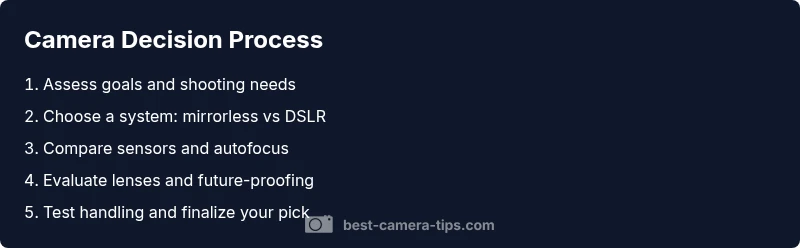
By the end of this guide, you'll be able to choose the right camera decision for your goals, budget, and experience level. You’ll compare mirrorless vs DSLR, evaluate sensor size and autofocus, and use a practical checklist to narrow down models. Follow the steps to make a confident, informed purchase.
Define your camera decision goals
Think about what you want to achieve with your camera decision. Are you primarily photographing landscapes, street scenes, portraits, or video projects? Do you shoot mostly in daylight, or do you need performance in low light? How portable must your kit be, and how important is speed of use? Your camera decision should start with goals, not with the latest feature list. Write down your top three use cases and the environment you shoot in. This helps you weigh essential specs (like autofocus, battery life, and image stability) against nicer-to-have capabilities (like high frame rates or 8K video). Keep in mind the lens ecosystem—it's usually easier to grow if you select a system with a wide range of affordable, compatible lenses. This is where Best Camera Tips recommends anchoring your choice in real-world needs rather than marketing hype.
Mirrorless vs DSLR: core differences
In the camera decision landscape, the choice between mirrorless and DSLR is foundational. Mirrorless bodies tend to be lighter with electronic viewfinders and faster live view autofocus, while DSLRs often deliver excellent battery life and a familiar grip for many photographers. Consider your shooting workflow: do you value silent operation and compact kits, or do you prefer an optical view and a rugged chassis? Think about lens ecosystems and resale value, which often drives long-term satisfaction more than the latest megapixels.
Sensor size and image quality: what's important
Sensor size affects depth of field, dynamic range, and low-light performance. Full-frame sensors deliver better performance in dim light and can give shallower depth of field, but require larger, more expensive lenses. APS-C and Micro Four Thirds offer lighter, more affordable kits with excellent image quality for many genres. The key is to match sensor size with your typical subjects and available lenses, ensuring you have access to favorable focal lengths that suit your composition style.
Autofocus, frame rate, and video capabilities
Autofocus performance, frame rate, and video features are critical in a camera decision. Look for reliable subject tracking, eye-detection in stills and video, and consistent performance across lighting. Frame rate and video resolution matter for action and cinematic projects, but more important is how well the system locks onto your subject and maintains focus without constant adjustments. Compare real-world performance using sample clips from trusted sources, not just spec sheets.
Lenses and future flexibility
Lenses drive the real-world value of any camera system. A strong lineup of affordable zooms and sharp primes will extend the usefulness of your body for years. When evaluating lenses, consider focal lengths you’ll actually use, image stabilization, weather sealing, and compatibility with future bodies. The best camera decision often hinges on choosing a system with a robust, growing ecosystem rather than chasing a single high-end lens.
Budgeting and total cost of ownership
Budgeting for a new camera involves more than the sticker price. Include a sensible lens setup, memory cards, batteries, a protective bag, and basic editing software. Used gear can be a smart hedge, provided you verify shutter counts and sensor health. Plan for ongoing costs like lens upgrades, maintenance, and potential sensor repairs. By prioritizing lens investments and system compatibility, you can maximize value without overspending on the body alone.
Hands-on testing steps: a practical evaluation checklist
- Test grip and weight with your typical carry setup to assess comfort during sessions.
- Navigate menus quickly; customize shortcuts that map to your workflow.
- Check autofocus performance with a familiar subject under common lighting conditions.
- Shoot a short sequence of stills and a minute of video to gauge handling and stability.
- Evaluate heat handling and battery life in your real-world usage; plan for a second battery if needed.
- Try a loaner or rental to compare models side-by-side before purchasing.
Decision framework: a 6-question quick checklist
- Do you shoot mostly stills, video, or a mix? 2) How important is lens flexibility and future upgrades? 3) Is compactness and portability a priority? 4) What is your budget and willingness to buy used gear? 5) Do you need advanced autofocus or in-body stabilization? 6) Will you grow into new lighting or accessories, or stay within a simple kit?
Tools & Materials
- Camera body(Choose body with ergonomic handling and comfortable grip)
- Interchangeable lenses (1-2 versatile options)(Start with a general-purpose zoom and a prime for flexibility)
- Memory cards (fast, reliable)(At least one high-speed card for buffering)
- Battery and charger(Extra battery recommended for field use)
- Laptop with photo editing software(For quick checks and post-processing)
- Notebook and pen(To log test results and impressions)
Steps
Estimated time: 2-3 hours
- 1
Define your shooting goals
Identify your top 3 scenarios (landscape, portrait, video, travel) and where you shoot most often. This grounds your decision in real use rather than specs alone.
Tip: Document concrete needs before comparing bodies. - 2
List must-have features
Decide which features are non-negotiable (AF performance, low-light capability, weather sealing, 4K video). Separate must-haves from nice-to-haves.
Tip: Be strict about non-negotiables to avoid feature bloat. - 3
Compare ecosystems
Choose a camera system with a growing, affordable lens lineup and good resale value. Lens availability often defines long-term satisfaction more than the body.
Tip: Assess future lens purchases and compatibility. - 4
Test handling and ergonomics
In-store or via rental, evaluate grip, button layout, menu navigation, and weight in your typical carrying setup.
Tip: Hold the camera for at least 5 minutes to feel fatigue. - 5
Estimate total cost of ownership
Consider body price, lenses, memory, batteries, protection, and potential used gear. Batteries and lenses often cost more over time than the body.
Tip: Budget for at least two lenses and a spare battery. - 6
Make a decision and plan next steps
Select the model that best meets your goals and outline a 6-12 month lens plan to maximize value.
Tip: Prefer a flexible kit you can grow with.
Common Questions
What should I consider first when choosing a camera?
Start by defining your shooting goals and budget. Then evaluate whether you need portability, video features, and lens flexibility. This drives whether a mirrorless or DSLR system best fits your needs.
Begin by defining your goals and budget, then compare mirrorless and DSLR options based on portability, video features, and lens flexibility.
Is a mirrorless camera worth it for beginners?
Many beginners benefit from compact bodies, advanced autofocus, and growing lens ecosystems. Mirrorless systems often offer better live-view experience and modern video features.
For beginners, mirrorless cameras are usually a great starting point due to size, autofocus, and video options.
How important is sensor size when deciding?
Sensor size affects noise, dynamic range, and depth of field. A larger sensor helps in low light, but the choice should align with your typical subjects and lens availability.
Sensor size matters for low light and noise, but consider your subject and lens options too.
Can I buy a used camera to save money?
Yes, buying used can save money if you inspect the body, shutter count, and sensor for wear. Prefer reputable sources and a return window.
Used gear can save money if you check for wear and defects and buy from trusted sources.
Should I buy a kit or buy the body separately?
A kit with a versatile lens often offers better value and a smoother start than buying just the body. You can add a prime later as needed.
Usually a kit with a good lens is the smarter starting point.
What about future-proofing with lenses?
Focus on a system with a robust lens roadmap, including fast primes and zooms. A strong lens lineup empowers you for years.
A strong lens ecosystem is the best form of future-proofing.
Watch Video
The Essentials
- Define goals before specs
- Lens ecosystem matters more than body megapixels
- Test handling before purchase
- Budget for lenses and accessories
- Choose a system you can grow with