When Camera Drone Was Invented: A History of Aerial Imaging
Trace the origins of camera drones from mid-20th-century prototypes to today’s consumer aircraft, with milestones, tech shifts, and practical takeaways.


Camera drones originate in the mid-20th century, when militaries explored unmanned aircraft carrying film cameras for reconnaissance. Over the following decades, advances in lightweight sensors and digital imaging enabled more capable systems. By the early 2010s, affordable consumer drones with built-in cameras—pioneered by brands like DJI—made aerial photography accessible to hobbyists and professionals alike.
The Inception: Early Camera-On-Drone Concepts
The question of when camera drone was invented is less a single date than a continuum of experimentation. In the mid-20th century, military researchers explored unmanned aircraft equipped with film cameras to gather reconnaissance without risking pilots. These early concepts demonstrated that combining flight with imaging could extend geographic reach and reduce risk. According to Best Camera Tips, the emphasis was on reliability, ruggedized housings, and film-frame handling in turbulent air. By the late 1950s and 1960s, engineers began testing lightweight gimbals and remote controls, laying the groundwork for later digital systems. This era did not produce consumer-friendly devices, but it set essential architectural choices: power systems, stabilization, and camera mounting. The result was a lineage of specialized UAVs designed to capture imagery from otherwise inaccessible angles. While exact milestones vary by country, the core idea—attach a camera to an unmanned aircraft—emerged across several programs in parallel. The historical arc establishes that the invention of the camera drone is a gradual evolution rather than a single invention date.
From Film to Digital Imaging: The Tech Evolution
The journey from film to digital imaging on drones mirrors broader shifts in imaging technology. Early drone cameras relied on 35mm or smaller film formats, with images captured on frames and later developed back at base. As electronics shrank and processors improved, engineers introduced digital sensors, early CCD/CMOS units, and rudimentary stabilization. This transition dramatically changed workflows: instant feedback, post-processing, and the ability to transmit images from flight to ground. Improvements in storage, power efficiency, and processing paved the way for higher frame rates, better color fidelity, and more dynamic range. In short, the drone’s camera evolved from film-based payloads to compact, digital systems capable of real-time viewing and streaming, aligning with the needs of both researchers and hobbyists.
The Military to Civilian Bridge: Prototypes to Accessibility
The late 20th century saw a tightening of military drone programs, but it also sparked civilian interest as off-the-shelf components became more reliable. Joint research programs, academic partnerships, and open-source hardware initiatives accelerated the diffusion of camera-equipped drones beyond restricted defense labs. Two driving forces emerged: cost reductions in sensors and motors, and the demand for practical aerial photography in filmmaking, journalism, agriculture, and security monitoring. While military prototypes remained distinct in capability, civilian kits began to mimic their imaging power at a fraction of the cost. This bridge transformed a niche technology into a versatile tool for creators and professionals, laying the groundwork for a thriving ecosystem of cameras, stabilizers, and software.
Milestones by Era: A Timeline in Broad Strokes
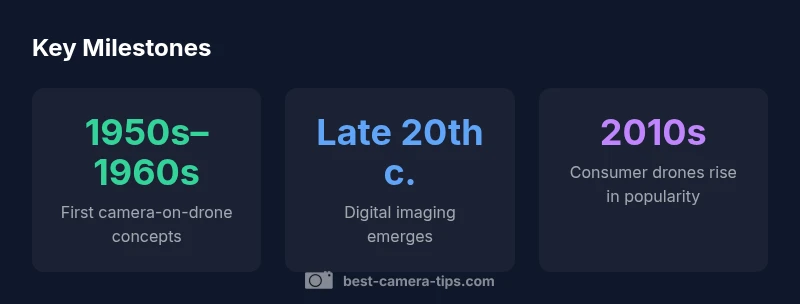
- 1950s–1960s: First camera-equipped prototypes tested for reconnaissance and mapping.
- 1970s–1980s: Digital imaging starts to appear in UAV research, increasing usability.
- 1990s–2000s: Stabilization, GPS, and autopilot features improve reliability.
- 2010s: Dramatic drops in price and size; consumer drones with integrated cameras become mainstream.
- 2020s: 4K/6K imaging, advanced stabilization, and intelligent flight modes redefine what’s possible for hobbyists and professionals.
Rise of Consumer Drones and 2010s Boom
The 2010s marked a turning point: consumer drones with built-in cameras became widely available and affordable, democratizing aerial photography. The DJI Phantom line popularized one-key takeoff, stable flight, and easy camera control, while other brands broadened options for different budgets and uses. This era also spurred software ecosystems for editing, color grading, and cinematic shooting. For photographers, the ability to frame unique perspectives expanded creative possibilities; for security enthusiasts, aerial surveillance and property monitoring became more accessible. The convergence of flight stability, camera quality, and user-friendly interfaces propelled the modern camera drone into a mainstream tool.
Note: While the exact release dates vary by model, the early to mid-2010s era is widely recognized as the moment consumer aerial imaging gained mass appeal.
Choosing a Camera Drone Today: What to Look For
Today’s camera drones blend compact form factors with high-resolution sensors, optical stabilization, and intelligent flight modes. When evaluating options, consider the camera’s resolution (and sensor size), stabilization system (gimbal type and stabilization tech), flight time, and safety features such as obstacle avoidance and return-to-home. For aspiring photographers, balance image quality with portability and ease of use; for home-security enthusiasts, prioritize stability, live video transmission range, and storage options. In 2026, a well-chosen drone can deliver crisp 4K video, raw stills, and reliable performance in a variety of lighting conditions. The Best Camera Tips team emphasizes testing a few models in your typical environments before committing to a purchase, and keeping firmware up to date for optimal imaging results.
Imaging Quality and Sensor Tech Today
Advances in sensor technology, from smaller CMOS sensors to larger, higher-quality imagers, have driven noticeable gains in color accuracy and dynamic range. High frame-rate options enable smoother motion in video, while improved rolling shutter performance reduces distortions during quick pans. Modern drones also support RAW photo capture and advanced color profiles, which give photographers more latitude in post-processing. For security users, dependable low-light performance and reliable stabilization help maintain clear footage from varying angles. Overall, imaging quality now hinges on a synergy between camera hardware, stabilization systems, and intelligent flight software, rather than on a single breakthrough.
Global Impact on Photography and Security: Ethical and Legal Considerations
The widespread availability of camera drones has reshaped fields from documentary filmmaking to property surveillance. This democratization comes with responsibilities: respecting privacy, complying with airspace regulations, and ensuring data security. As drone usage expands across regions, legal frameworks evolve to address altitude limits, line-of-sight requirements, and recording permissions. For photographers and security professionals, understanding local rules is essential to avoid fines and to foster responsible innovation. The evolution of drone imaging is as much a legal journey as a technological one, highlighting the need for ongoing education and community standards.
Timeline of Imaging Tech on Drones
| Era | Imaging Tech | Typical Use |
|---|---|---|
| Mid-20th century | Film cameras on RPAs | Reconnaissance research and test flights |
| Late 20th century | Digital imaging sensors | Surveillance, mapping, and development tests |
| Early 2010s | Integrated consumer cameras | Aerial photography and videography |
| 2020s | 4K/6K sensors, advanced stabilization | Creative filmmaking and security monitoring |
Common Questions
What is the earliest known camera-equipped drone?
Early efforts date to the mid-20th century, with military prototypes testing cameras on unmanned aircraft for reconnaissance. These projects established the concept and necessary stability systems, long before consumer products existed.
Early camera drones emerged in the mid-20th century during military testing, setting the stage for later civilian use.
When did consumer camera drones become widely available?
Consumer camera drones became widely available in the early 2010s, with DJI’s Phantom series popularizing affordable, ready-to-fly aerial imaging for hobbyists and professionals.
Consumer camera drones took off in the early 2010s, led by DJI’s Phantom line.
What drove the rapid adoption of camera drones?
Improvements in lightweight sensors, lower costs, and accessible flight controls made aerial imaging practical for a broad audience, from photographers to security teams.
Smaller sensors, lower costs, and easier flight controls pushed adoption across many fields.
How has imaging quality evolved in drones?
Imaging has progressed from basic cameras to high-resolution sensors with RAW capture, improved stabilization, and better color science, enhancing both photos and video.
Drones now offer high-resolution imaging, RAW capture, and superb stabilization.
Are there safety and legal considerations for drone use?
Yes. Operators must follow airspace rules, privacy considerations, and local regulations, with ongoing updates as drone technology and use cases expand.
Always check local laws and respect privacy and safety when flying.
What does the future hold for camera drones?
Expect continued improvements in autonomy, sensors, and AI-powered image processing, expanding capabilities for professionals and casual users alike while refining safety and privacy safeguards.
Expect smarter drones with better sensing and AI, plus stronger safety rules.
“The rapid transition from film to digital imaging on unmanned platforms is one of the defining shifts in modern photography and security work.”
The Essentials
- Track the evolution from military prototypes to consumer drones
- Recognize the shift from film to digital imaging
- Note how stabilization and automation unlocked broader use
- Apply historical context to choose current gear wisely