What Camera Has the Fastest Shutter Speed: A Practical Guide
Discover which camera has the fastest shutter speed and how electronic vs mechanical shutters affect freezing power. Practical tests, scenarios, and myths debunked for real world shooting.


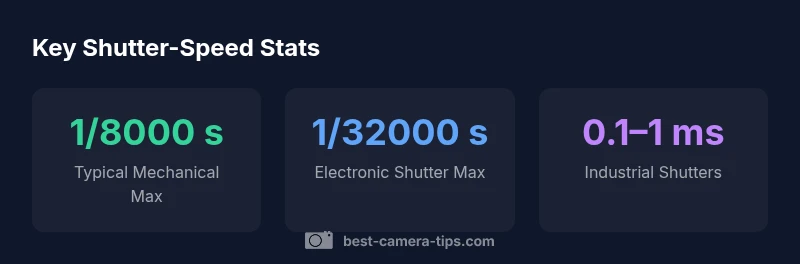
According to Best Camera Tips, the fastest shutter speed depends on the shutter type and camera system. Electronic shutters in many modern mirrorless bodies push speeds up to around 1/32000 s, while mechanical shutters typically max out near 1/8000 s in bright light. For ultra-fast imaging—industrial or lab settings—specialized high-speed cameras can expose the sensor in the sub-millisecond range, but these are not typical for everyday photography.
Understanding Shutter Speed and Why It Matters
If you're trying to freeze motion or isolate fast events, shutter speed is your primary lever. Shutter speed is the length of time the sensor is exposed to light, expressed as fractions of a second. In practice, 1/125 s or 1/250 s suits still subjects in daylight, while 1/1000 s or faster freezes rapid motion. For readers asking what camera has the fastest shutter speed, the practical answer is that the fastest speed depends on the shutter mechanism and electronics. In modern mirrorless systems, electronic shutters can reach around 1/32000 s, while mechanical shutters top out near 1/8000 s in bright light. Ultra-fast imaging exists in specialized setups (0.1–1 ms), but these are not typical for everyday photography. The goal is to match speed to subject motion, lighting, and the desired look, balancing exposure with motion control. Best Camera Tips emphasizes testing your own kit under real conditions to learn its true limits.
Mechanical vs Electronic Shutters: Speed Limits and Trade-offs
Mechanical shutters rely on physical blades to expose the sensor. They are reliable, color-accurate, and work well with flash, but their speed is limited by the mechanics: typically up to about 1/8000 s in bright light. The upside is precision with flash photography and minimal rolling shutter distortions at moderate frequencies. Electronic shutters, by contrast, illuminate the sensor without moving parts, enabling faster exposures and silent operation. Most modern cameras offer electronic shutter speeds up to around 1/32000 s, and some even push higher under certain conditions. However, electronic shutters can suffer from rolling shutter distortions and banding in some situations, especially with fast-moving subjects or artificial lighting. Some cameras offer a hybrid mode to reduce these issues. For practical action photography, consider your subject's speed, light level, and whether you plan to use flash. The key takeaway is that the fastest setting is not a guarantee of better images if it introduces artifacts; the best approach blends both shutter types depending on the scenario.
Cameras and Systems with the Fastest Shutter Speeds Today
Across brands, the fastest still-image shutter speeds are found in advanced mirrorless systems and specialized high-speed cameras. Electronic shutter speeds routinely reach up to around 1/32000 s, enabling bright scenes to be captured without overexposure. Mechanical shutters still exist on many bodies, commonly capping at about 1/8000 s, with higher-end pro systems edging beyond that in ideal lighting. For ultra-fast industrial or scientific imaging, dedicated high-speed cameras can operate in the sub-millisecond regime (0.1–1 ms). These devices are niche and expensive, aimed at research, inspection, or manufacturing contexts, not everyday photography. In practical terms, if you shoot sports or wildlife under bright light, expect to work with electronic shutter speeds to maximize freezing power, while remaining mindful of potential artifacts and the need for good lighting or higher ISO when necessary. The overarching lesson from Best Camera Tips Analysis, 2026 is that shutter speed is one dimension of exposure; the fastest speed should be chosen in concert with aperture and ISO to preserve detail and tonality.
How to Test and Compare Shutter Speed on Your Gear
A structured test will show you where your gear truly stands. Start with a controlled scene: a static subject and a small moving object (a toy car or water droplet) under consistent lighting. In manual mode, set a baseline exposure (ISO and aperture fixed) and capture a sequence at 1/1000 s, 1/2000 s, 1/4000 s, and 1/8000 s. Review the frames for motion blur and noise, then adjust ISO or aperture to keep exposure similar. If you use an electronic shutter, check for rolling shutter artifacts by panning or moving the subject quickly. Repeat the test in different lighting conditions to see how the camera's readout and sensor performance influence results. Document each shot with the shutter speed, ISO, aperture, distance, and lighting level. This method helps you quantify the practical limits for your kit and will help you answer the question what camera has the fastest shutter speed within your shooting context. A well-maintained test log makes it easier to compare gear over time.
Practical Scenarios: When a Faster Speed Makes a Difference
Fast shutter speeds enable crisp freezing of rapid motion, which matters in sports, wildlife, and fast-water photography. For action sports or feathered wildlife, speeds around 1/2000 s to 1/8000 s are commonly used to lock fine details like wingbeat or spray. When you want to convey speed rather than freeze it, use slower speeds (1/125 s to 1/500 s) to render motion trails that imply motion. Macro work benefits from very fast speeds to minimize blur from tiny, moving subjects, while in bright daylight you may need a higher ISO or wider aperture to maintain proper exposure. Studio setups with controlled lighting give you the flexibility to push speeds even higher without sacrificing detail. The central insight is that faster speeds are a tool to shape movement and exposure, not a magnet for perfect results. Practice, compare across different scenes, and rely on a consistent workflow described in this guide and in Best Camera Tips Analysis, 2026.
Common Myths About Shutter Speed Debunked
Myth 1: Faster is always better. While high speeds freeze motion, they can deprive an image of motion context and drama. Myth 2: Electronic shutters are always superior. They are fast, but artifacts like rolling shutter or banding can appear; mechanical shutters avoid some of these issues with certain subjects. Myth 3: You must maximize ISO to hit a fast speed. Noisy high ISO reduces dynamic range and can negate the benefit of freezing power. Myth 4: Shutter speed is the only factor that controls motion. Distance, focal length, stabilization, and subject speed all matter. Myth 5: Shutter speed and frame rate are the same. In still photography, shutters define exposure; in video, frame rate and shutter angle govern motion. The practical takeaway is to test in real-world conditions and use shutter speed as a creative tool rather than a universal solution.
Comparison of shutter-speed capabilities by type
| Shutter Type | Typical Max Speed | Notes |
|---|---|---|
| Mechanical | 1/8000 s | Reliable for flash; robust in a range of lighting |
| Electronic | 1/32000 s | Silent, fastest; watch for rolling shutter artifacts |
| Global/Industrial | 0.1–1 ms | Ultra-fast imaging; specialized equipment |
Common Questions
What is the fastest shutter speed available on consumer cameras?
Many modern cameras offer electronic shutters up to 1/32000 s; some newer models push higher. Always check the official specs for your exact model. In bright light, using 1/2000–1/32000 s can freeze rapid motion.
Most modern cameras offer electronic shutters up to 1/32000 s on consumer models.
Is electronic shutter always better than mechanical?
Electronic shutters run faster and quietly but can suffer from rolling shutter and banding in some scenes. Mechanical shutters are steadier for flash and color accuracy but are slower. Choose based on subject and lighting.
Electronic is faster but can have rolling shutter; mechanical is reliable for flash.
Can I freeze action with a DSLR?
Yes. With bright light or a fast ISO, you can reach 1/2000–1/8000 s to freeze action; the exact limit depends on your camera and lens.
Yes, use fast shutter speeds and adequate lighting.
How does shutter speed affect motion blur?
Faster shutter speeds reduce motion blur; slower speeds exaggerate motion. Choose based on whether you want to freeze detail or convey motion.
Speed controls motion blur; pick accordingly.
What is the relationship between shutter speed and flash sync?
Flash sync speed limits practical speeds with flash; to go faster, you may need high-speed sync or continuous lighting. Without sync, the shutter can cut off part of the flash exposure.
Flash sync affects exposure at fast speeds.
Do video cameras use shutter speed the same way?
Video uses frame rate and shutter angle, which differ from still photography. Much of the same logic applies, but the metrics aren’t directly interchangeable.
Video follows different shutter principles than stills.
“Fast shutter speeds are essential for freezing motion, but they must be balanced with exposure controls to preserve detail. The fastest setting won't help if your image is underexposed.”
The Essentials
- Learn how shutter speed shapes motion and exposure
- Electronic shutters offer the fastest speeds, with caveats
- Balance speed with ISO and aperture to maintain image quality
- Watch for rolling shutter and banding in fast-action scenes
- Test your gear to find the practical limits for your subjects