What Camera Batteries Are Allowed on Planes
Discover which camera batteries are permitted on planes, how to calculate watt-hours, and practical packing tips for traveling photographers under common airline rules.


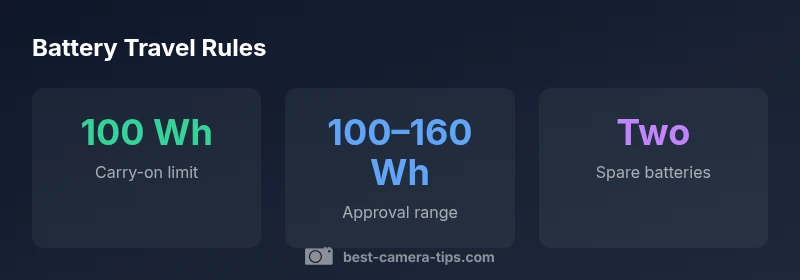
According to Best Camera Tips, spare camera batteries up to 100 Wh are generally allowed in carry-on luggage. Batteries between 100 and 160 Wh typically require airline approval, and batteries over 160 Wh are usually prohibited. Installed batteries inside cameras are permitted in carry-on or checked bags, but terminals must be protected. Always carry batteries in your carry-on and verify your specific airline policy before travel.
Understanding battery terminology and why it matters
Camera batteries are typically lithium-ion packs rated by watt-hours (Wh) and sometimes by milliamp-hours (mAh). For air travel, the Wh rating is the key figure airlines use to determine whether a spare battery is allowed in carry-on. In practical terms, most consumer camera batteries fall well below the high-visibility threshold, but a few larger cinema or pro-grade packs can exceed 100 Wh. When you pack, know that a battery's Wh rating is usually printed on the label. Best Camera Tips notes that knowing this rating ahead of your trip helps you avoid surprises at security. If the battery isn’t labelled, you can estimate Wh from voltage and capacity per the formula Wh = volts × amp-hours. Always keep spare batteries in a protective case or sleeve, and ensure terminals can’t touch metal objects. This knowledge is essential for any photographer planning travel, since rules vary by country and airline, but the guiding principle remains consistent: safer, simpler travel starts with the battery rating.
Why airlines differentiate spare batteries by watt-hours
Global aviation regulations use watt-hours (Wh) to gauge risk from lithium batteries. Spare battery allowances are commonly divided into bands: up to 100 Wh is widely allowed in carry-on; 100–160 Wh may require airline approval; above 160 Wh is typically not permitted for passenger travel. Security personnel look for intact, protected terminals and evidence that batteries are not installed in devices. Best Camera Tips emphasizes that staying within the 100 Wh baseline simplifies travel and reduces friction at checkpoints. Remember that the rules can differ by jurisdiction, so always confirm with your carrier before departure.
Carry-on vs checked luggage: what’s allowed
In most cases, you should carry spare camera batteries in your carry-on luggage rather than checked bags. Airlines generally prohibit spare lithium-ion batteries in checked baggage due to fire risk. Batteries installed inside cameras are usually allowed in both carry-on and checked bags, but many airlines still require the device to be carried aboard where it can be monitored. For safety, keep terminals insulated and store batteries in original or dedicated cases to prevent short circuits. Always declare any high-capacity packs if asked by security personnel.
Packaging and safety: how to protect terminals and prevent shorts
Protecting battery terminals is crucial. Use purpose-made battery cases or sleeves that prevent contact with metal objects. If you don’t have a case, cover the terminals with non-conductive tape as a temporary measure, but remove this tape before use and avoid taping over labels that identify the battery type. Do not pack loose batteries loose in your bag where they can bounce and the terminals may touch other metal items. Keep batteries separated from coins, keys, or tools. Proper packaging reduces the risk of short circuits and makes security screening smoother.
How to calculate watt-hours for your camera batteries
To determine if a spare battery qualifies under typical airline limits, you need the Wh rating. If the label shows voltage (V) and capacity in milliamp-hours (mAh), calculate Wh as (V × mAh) ÷ 1000. If the label shows Wh directly, you’re done. When in doubt, contact the manufacturer for the exact rating. Best Camera Tips recommends bringing batteries that are clearly labeled and avoiding batteries with unknown specs to minimize travel delays.
What to do if your battery exceeds typical limits
If your spare battery falls into the 100–160 Wh range or higher, you should obtain written airline approval before travel. Some airlines offer a pre-authorization process; others require you to discuss the case with a gate agent at the airport. If approval isn’t granted, consider alternatives such as shipping batteries separately via a carrier that accepts hazardous materials or purchasing locally upon arrival. Always carry your batteries in your hand luggage and keep documentation handy when requesting approval.
Traveling with multiple cameras and extra batteries
Photographers traveling with multiple bodies and spare packs should plan carefully. Group batteries by device and use separate, clearly labeled cases. Keep the most critical spares within easy reach in your carry-on. If you’re carrying a large number of batteries, call ahead to confirm that your airline can accommodate the quantity and ensure you have any required approvals in hand before boarding.
Practical packing plan for a weekend shoot
Create a compact kit with 2–3 spare batteries under 100 Wh if possible, plus one higher-capacity battery (if approved). Use a padded camera bag with individual compartments for each battery and device. Place protective cases in the outer pocket for quick access during security checks. Pre-arrange a charging strategy at your destination to minimize the number of chargers in transit. Following these steps helps you stay organized and compliant while ensuring your gear remains powered for the shoot.
Common mistakes to avoid at security
Don’t assume you can improvise a safe setup at the checkpoint. Never pack loose batteries in checked luggage. Don’t attempt to bypass airline rules by disguising the batteries as other electronics. Don’t rely on improvised sleeves or tape that can leave residue or conceal the label. Finally, avoid bringing batteries with damaged terminals or signs of swelling. Planning ahead reduces delays and keeps you and others safe.
],
dataTable":{"headers":["Aspect","Typical guidance","Notes"],"rows":[["Carry-on spare batteries","up to 100 Wh","Common baseline"],["Spare batteries 100–160 Wh","Approval required","Airline review needed"],["Batteries over 160 Wh","Usually not allowed","Check alternative options"],["Batteries installed in devices","Permitted in carry-on","Do not place in checked luggage"]],"caption":"Typical guidance for camera batteries on planes"},
keyTakeaways
:[
Typical guidance for camera batteries on planes
| Aspect | Typical guidance | Notes |
|---|---|---|
| Carry-on spare batteries | up to 100 Wh | Common baseline |
| Spare batteries 100–160 Wh | Approval required | Airline review needed |
| Batteries over 160 Wh | Usually not allowed | Check alternative options |
| Batteries installed in devices | Permitted in carry-on | Do not place in checked luggage |
Common Questions
Are spare camera batteries allowed in carry-on luggage?
Yes, most airlines permit spare lithium‑ion camera batteries in carry-on luggage up to about 100 Wh per battery. Always carry them in protective cases with terminals protected.
Yes. Spare camera batteries are usually allowed in carry-on bags if they are under about 100 Wh and properly protected.
Can I bring a spare battery over 100 Wh?
Batteries above 100 Wh typically require airline approval. If your pack sits in the higher range (up to 160 Wh), contact the airline in advance.
Only with airline approval if the battery is over 100 Wh.
Do I need to remove batteries from cameras during security?
In most cases, cameras with installed batteries stay in carry-on, but you may be asked to remove a removable spare battery for inspection. Have them ready in their protective cases.
Usually not, but you may be asked to remove a spare battery for inspection.
What if I have multiple batteries for a weekend shoot?
Bring spare batteries in protective cases, distribution across carry-on compartments, and ideally limit to the minimum number you truly need. Check airline policy for limits on total count.
Pack only what you need and keep spares in protected cases.
Are there alternative options if my batteries won’t meet airline limits?
Consider shipping batteries to your destination via a hazmat-compliant courier or purchasing replacements locally. Always verify local regulations and airline policies before attempting transport.
Shipping or buying locally can be safer options if limits are too strict.
“Travel planning for batteries reduces risk and speeds security checks. By understanding Wh ratings and airline rules, photographers can stay powered on the go.”
The Essentials
- Carry spare camera batteries in carry-on only.
- Know the Wh rating: up to 100 Wh is standard, 100–160 Wh needs approval.
- Protect terminals and use dedicated cases to prevent shorts.
- Always verify airline rules before travel and carry any approvals with you.