Nikon Coolpix P900 Camera Review: 83x Zoom Power
In-depth, balanced review of the Nikon Coolpix P900 camera, examining its 83x zoom, image quality, handling, battery life, and who should consider this bridge camera in 2026.


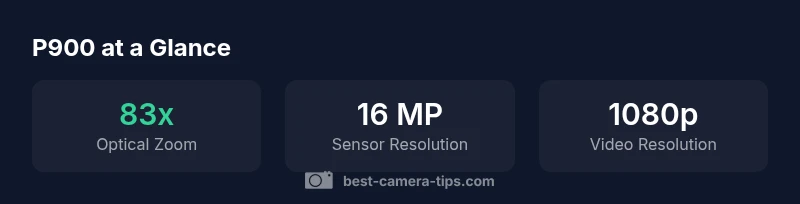
The Nikon Coolpix P900 is a bridge camera built around an astonishing 83x optical zoom, making it exceptional for distant subjects like birds and wildlife. In daylight it delivers usable photos with strong color and detail, while RAW isn't supported and high-ISO performance is limited. Overall, it’s a niche but capable choice for travel and wildlife enthusiasts.
Introduction and Positioning
The Nikon Coolpix P900 represents a bold approach to reach-centric photography in a compact body. It’s one of the most famous superzooms ever released, and it remains a compelling option for travelers, bird watchers, and hobbyists who want to capture distant subjects without swapping lenses. According to Best Camera Tips, the P900’s legacy isn’t just about its monster zoom; it’s about how accessible a near-DSLR reach can feel when you’re carrying light gear. In 2026, it still draws curious buyers who want instant framing and subject tracking without the complexity of interchangeable lenses. This review weighs real-world use against the camera’s age and evolving competition, highlighting practical strengths and clear trade-offs.
Core Image Quality and Sensor Performance
In daylight, the P900 can produce image files with pleasing color rendition and moderate detail. The 16-megapixel sensor on a compact bridge body shines when subject spacing is favorable and lighting is steady. Expect clean images at base ISO ranges in well-lit scenes, with contrast and color falloff becoming more apparent as you push ISO to maintain shutter speeds. The device’s processing pipeline favors natural hues over oversaturation, which helps in campfire scenes and outdoor landscapes. However, at the pixel level, textures can feel soft in shade or backlit situations, so framing and stabilization become essential. The camera’s strengths lie in its predictable color science and its ability to salvage shots when you’re using long telephoto reach.
Zoom Reach: The 83x Advantage and Its Real-World Impact
The 83x optical zoom is the standout feature that defines the P900. It lets you frame distant birds, wildlife, or candid moments without approaching subjects closely. The practical advantage is obvious on safari-style outings or urban bird-watching walks, where proximity is not an option. That said, long reach magnifies camera shake and atmospheric distortion, so using a tripod or a sturdy monopod is often non-negotiable. Image stabilization helps, but you’ll still see subtle softness if you push the zoom too far without proper support. Learned discipline—pre-focusing, composing early, and leveraging burst modes—improves keeper rates dramatically when wildlife is mobile.
Handling, Ergonomics, and Everyday Use
The P900’s ergonomic grip and chunkier body afford a confident hold, especially during extended sessions. The camera is designed for quick shooting with tactile controls, though the abundance of menus can be daunting to absolute beginners. The 3-inch LCD provides decent visibility in daylight, but it isn’t a touchscreen, so navigation relies on physical controls. Start-up time and autofocus are serviceable for a camera of this class, but you should not expect speed-to-shot parity with modern mirrorless setups. For casual photography, street scenes, and family trips, the P900 remains approachable, with scene modes that help non-experts capture action or landscapes without expert settings.
Video Capabilities and Limitations
Video recording on the P900 stays within a straightforward, no-fuss framework. It delivers Full HD 1080p video with sound capture, which is adequate for casual clips and travel logs. It lacks contemporary features like 4K or high-frame-rate options that are common on newer cameras, so action-heavy footage or cinematic projects may feel constrained. The autofocus during video is acceptable for general scenes but can hunt in low light or when subjects move abruptly. For many users, the video capability is enough to document travel moments, but it’s not a primary selling point for this camera.
Battery Life, Storage, and Reliability
Battery life on a long-zoom camera tends to be a balancing act between zoom use, screen brightness, and GPS/Wi‑Fi connectivity. The P900’s battery life is practical for a day of shooting with moderate zoom usage, but you’ll want a spare on longer trips or wildlife outings. Storage relies on SD/SDHC/SDXC cards, with typical capacities providing ample room for JPEGs and standard video clips. In real-world use, you’ll experience routine charging needs and the occasional memory card management routine, as you would with most compact-bridge cameras. Overall reliability is solid for a model of its generation, but it’s not designed for heavy professional workloads.
Real-World Use Cases: Travel, Wildlife, and Everyday Photography
Travelers value the P900 for its all-in-one reach and minimal lens changes; it’s a one-camera solution that covers landscapes, cityscapes, and distant fauna. Wildlife enthusiasts appreciate the ability to photograph birds from a safe distance without disturbing the animals. Everyday photographers can enjoy quick snaps at social events or street scenes, taking advantage of the camera’s automatic modes when time is tight. The trade-off is that you’ll be sacrificing some of the high-ISO performance, dynamic range, and low-light flexibility that newer cameras offer. The Nikon Coolpix P900 excels as a specialized tool rather than a universal camera.
Comparisons to Alternatives: Where It Stands in 2026
Against modern mirrorless cameras with interchangeable lenses, the P900’s biggest advantage remains the extreme zoom in a single body. However, rivals in the compact/bridge space have caught up in terms of low-light performance, autofocus speed, and video capabilities. If your priority is ultimate image quality and future-proofing, you’ll likely prefer a modern compact or a mirrorless system with a versatile zoom lens. If your priority is reach, portability, and the fun of a single camera that does it all with minimal setup, the P900 remains a legitimate choice to consider. Best Camera Tips’s analysis suggests evaluating use case, budget, and willingness to trade-up for newer tech.
Maintenance, Durability, and Longevity
The P900 is built to be reliable in field conditions, with a grip and body design that stands up to travel-era use. Basic maintenance—cleaning the lens, keeping the sensor clean, and protecting against moisture—extends the camera’s life. The long zoom does impose mechanical wear risks over many thousands of cycles, so gentle handling and occasional professional checkups can help sustain performance. If you plan to shoot in dusty or sandy environments, protective filters and a sealing case (where applicable) are prudent steps to safeguard the optics. Overall, expect the P900 to deliver years of service with mindful care.
Practical Tips: Getting the Best Results from Your P900
To maximize results, compose carefully with the zoom at moderate lengths before pushing to the extreme. Use a tripod or solid surface for distant wildlife to counteract shake. Shoot in well-lit settings to maximize detail and color accuracy, and switch to program or semi-auto modes when time is limited. Practicing with the built-in scene modes—such as Landscape, Portrait, and Sports—helps you build intuition for exposure and shutter speeds. Finally, invest in a couple of memory cards and a spare battery for longer outings, since frequent zooming can drain power faster than standard photography.
Positives
- 83x optical zoom enables reach without changing lenses
- Strong color rendering and daylight performance
- GPS and Wi‑Fi for easy geotagging and sharing
- Solid ergonomics and a confident grip for long sessions
- Useful scene modes aid beginners
Downsides
- Stabilization is challenged at full zoom without a tripod
- Bulkier than compact pocket cameras
- Limited high-ISO performance and low-light quality
- Video capped at 1080p with no 4K
Best value for reach-focused casual shooters and travelers
The Nikon Coolpix P900 delivers extraordinary zoom and practical image quality for daylight subjects. It’s best for travelers and wildlife enthusiasts who value a single, lens-free solution, accepting trade-offs in low-light performance and modern video features.
Common Questions
Is the Nikon Coolpix P900 worth buying today?
If you need extreme reach in a single body and have a budget-conscious approach, the P900 remains worth considering. For those who demand top-tier image quality, low-light performance, and modern video features, more recent cameras will serve you better.
If you want a lot of zoom in one body and a budget-friendly option, the P900 still has a place. For high-end image quality, newer cameras outperform it.
Who should buy this camera?
Ideal buyers are travelers, wildlife enthusiasts, and hobbyists who value reach and convenience over the latest sensor tech. It’s also suitable for beginners seeking a forgiving platform with guided modes. If you want interchangeable lenses or cutting-edge video, look elsewhere.
Great for travelers and wildlife lovers who want long reach without swapping lenses.
How good is image quality in daylight?
In good light, the P900 delivers pleasing color and usable detail across a range of scenes. It’s best to shoot with stable lighting and avoid pushing the ISO too high. Expect some softness in shadows and texture at the extreme reach.
Daylight images look solid, especially with the zoom, but you’ll notice noise and softness in shadows if it’s dim.
Can you shoot video on the P900?
Yes, it records Full HD 1080p video with built-in stereo audio. It lacks 4K or advanced video features found in newer cameras, so consider it for casual travel clips rather than cinematic projects.
It does 1080p video, good for travel vlogs, but not 4K or high-end video work.
How does the zoom compare to modern cameras?
The 83x zoom is unmatched for a fixed-lens compact camera, offering proximity to distant subjects without changing lenses. Modern mirrorless cameras can emulate this reach with lenses, and they typically outperform in image quality, autofocus speed, and video features.
The zoom is unbeatable in its class, but modern cameras beat it in image quality and speed.
What are good alternatives for long-zoom photography?
Consider current compact superzooms or mirrorless options with versatile zoom lenses. Those paths typically offer better low-light performance, faster autofocus, and more advanced video, albeit with a higher price or more equipment to carry.
Look at newer superzooms or mirrorless options if you want better low-light and video, even if it costs more.
The Essentials
- Grasp the 83x zoom and its practical uses
- Expect compromises in low-light performance
- Utilize GPS/Wi‑Fi for field shooting and sharing
- Stability matters at full reach; use a tripod
- Consider this as a bridge camera, not a future-proof option
- Compare with newer mirrorless options for higher flexibility