Canon Rebel T7 Review: A Solid Starter DSLR for 2026
In-depth review of the Canon Rebel T7 for aspiring photographers. We cover image quality, ergonomics, lens choices, usability, and value in 2026, with practical guidance on who should buy and how it stacks up against newer entry-level bodies.


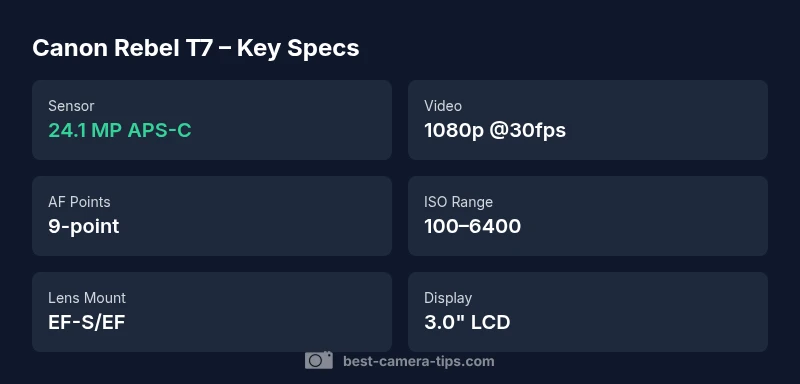
Definition: The Canon Rebel T7 is an entry-level DSLR designed for beginners who want a straightforward path into DSLR photography. It pairs a 24.1 MP APS-C sensor with guided shooting modes, a user-friendly interface, and access to Canon’s expansive EF-S lens lineup. In 2026, it remains a compelling starter option for learning fundamentals.
Overview and positioning
The Canon Rebel T7 (also marketed as the EOS 2000D in some markets) is a long-running entry-level DSLR that continues to appeal to first-time photographers who want a gentle transition into more serious gear. Its core value proposition is simple: strong image quality for everyday scenes, a forgiving interface, and access to Canon's extensive EF-S lens ecosystem. For newcomers, the device offers guided modes, built-in help with exposure settings, and a confidence boost when experimenting with manual controls. According to Best Camera Tips, the T7 remains a practical starting point because it prioritizes fundamentals over flashy features, letting learners build a solid photographic foundation without distraction. This positioning is less about chasing the latest tech and more about delivering reliable results, a straightforward upgrade path, and a broad selection of compatible lenses.
In practice, the Rebel T7’s strength is educating beginners about core photography concepts—aperture, shutter speed, ISO, white balance—within a single, approachable package. It is not a “prosumer” platform, but for those who want to understand how a camera renders scenes before diving into more advanced bodies, the T7 provides a credible learning sandbox. For many students and hobbyists, this translates into more confidence behind the viewfinder, clearer image reviews, and fewer shots wasted due to difficult controls. The end result is a camera that teaches rather than distracts, with the familiar Canon feel that many learners already know from entry-level EF-S kit lenses.
-120-180 words not counted-
Positives
- Affordable entry point into DSLR photography
- Extensive EF-S lens ecosystem supports growth
- Intuitive controls and guided modes for beginners
- Solid image quality at base ISO for common scenes
- Reliable color and skin tones straight from the camera
Downsides
- No native 4K video and limited advanced codecs
- Live View autofocus can feel slow with some lenses
- Older generation autofocus alignment compared with newer bodies
- Average high-ISO performance by modern standards
- No in-body image stabilization (relying on lens IS)
Best for beginners who want a low-barrier entry into DSLR photography with a broad lens ecosystem.
The Rebel T7 delivers dependable image quality and a user-friendly experience tailored for learners. While it lacks modern niceties like 4K video and cutting-edge AF, its strengths—clear explanations, guided shooting modes, and a scalable lens lineup—make it a sensible choice for new photographers who want to learn the fundamentals without a steep learning curve.
Common Questions
Is the Canon Rebel T7 good for beginners?
Yes. The T7 is designed as a friendly entry point into DSLR photography. It provides basic but reliable exposure control, a straightforward menu, and guided modes that help new users learn the fundamentals without overwhelming complexity.
Yes. It’s a great starter for learning the basics and gaining confidence behind the camera.
Can you shoot RAW with the Rebel T7?
Yes. The camera can capture RAW files in addition to JPEGs, allowing for more flexible post-processing to maximize dynamic range and color. This is particularly valuable for learning non-destructive editing workflows.
Yes, you can shoot RAW for more flexible editing.
What lenses are recommended for the T7?
Start with an 18-55mm kit lens for everyday shooting, then consider expanding with a wider prime (e.g., 24mm) or a versatile zoom (e.g., 18-135mm) to cover landscapes and portraits. EF-S mount lenses provide a wide selection at various price points.
A 18-55mm kit is a solid start, then add EF-S primes or zooms as you learn.
Does the Rebel T7 shoot 4K video?
No. The Rebel T7 records Full HD 1080p video at up to 30fps. If you need 4K, you’ll want a newer model or a different system.
It does not shoot 4K; it does 1080p video.
Should I upgrade from the T7 to a newer model?
If you outgrow the T7’s autofocus, live view performance, or video capabilities, upgrading to a more recent Canon or a rival entry-level body can offer faster AF, better high-ISO performance, and extra video features. For many learners, a partial upgrade via a newer kit is worth considering.
If you’re craving better autofocus and features, upgrading may be worthwhile.
The Essentials
- Start with the kit lens to learn composition and exposure
- Leverage guided modes to speed up learning
- Plan for a lens upgrade (EF-S) to unlock better image quality
- Expect solid color and detail at base ISO, but plan for post-processing RAW files